Part 1 — The Shirt
My daughter’s first day at her new school was supposed to be a fresh start.
New classroom. New teacher. New neighborhood.
After everything Emma had been through during the previous year, I wanted this morning to be simple. I wanted her to walk through those doors carrying nothing heavier than a new backpack and the ordinary nervousness of being eight years old.
Instead, before we even reached the entrance, I knew something was wrong.
It was Lauren’s shirt.
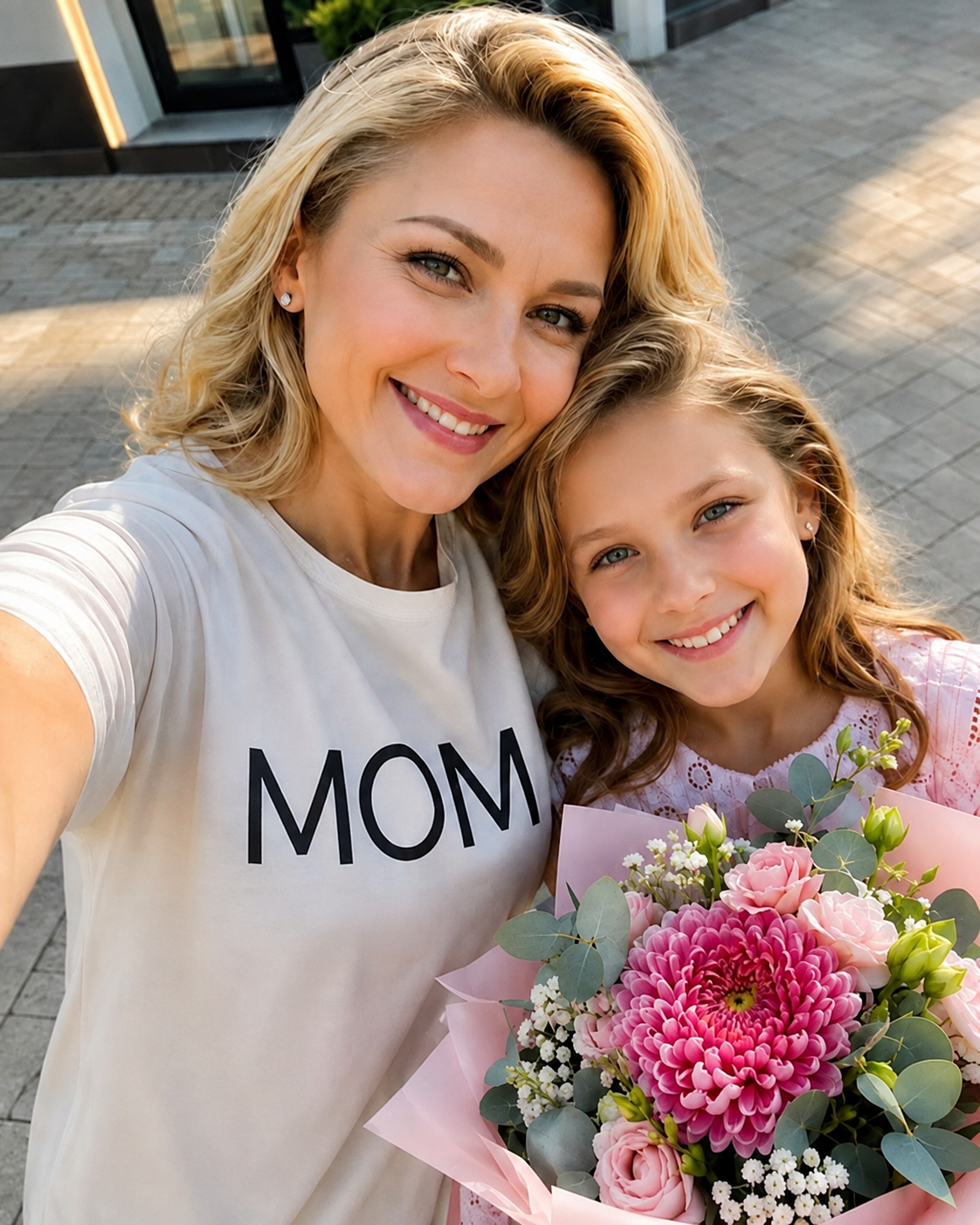
Bright blue, with enormous white letters printed across the front.
MOM.
I stopped walking.
Across the parking lot, my eight-year-old daughter was walking between my ex-husband, Ryan, and his new wife.
Emma’s fingers were wrapped tightly around the straps of her brand-new backpack. Her shoulders were stiff, and every few seconds she glanced toward the school entrance.
She looked nervous.
Not dramatically nervous.
Just quietly anxious—the kind of anxiety a mother notices immediately.
And the last thing she needed was tension between the adults who were supposed to be making her feel safe.
So I tried to ignore the shirt.
I really did.
I lasted about thirty seconds.
“Seriously, Lauren?”
She turned toward me.
“What?”
I pointed at her chest.
“You couldn’t have worn literally anything else today?”
Ryan sighed.
“Denise.”
“No. I’m asking her.”
Lauren looked down at the shirt as though she’d forgotten she was wearing it.
“Ryan gave it to me.”
Of course he did.
Somehow, that made the whole thing worse.
I looked at him.
“Of course you did.”
Before Ryan could answer, Emma stopped walking.
“Can we just go inside?”
Her voice was barely above a whisper.
That ended the argument.
I swallowed everything I wanted to say.
Today was supposed to be about Emma.
Whatever message Ryan thought he was sending with that shirt could wait.
We walked inside.
The hallway was filled with the usual first-day chaos. Parents carried coffee and paperwork. Children posed for photographs beneath colorful bulletin boards. Teachers stood outside their classrooms, greeting families and trying to remember dozens of new names.
For a few minutes, I managed to forget about Lauren.
Then we reached Emma’s classroom.
A woman with warm eyes and a welcoming smile stepped forward.
“Emma?”
Emma shyly raised her hand.
The teacher smiled.
“I’m Mrs. Collins. We’re so happy to have you here.”
I watched some of the tension leave my daughter’s face.
Then Mrs. Collins picked up a folder from her desk.
“Emma’s mom?”
“Yes,” I said.
At the exact same moment, Lauren said,
“Yes.”
The teacher froze.
She looked at Lauren.
Then me.
Then the folder.
Finally, she held it toward Lauren.
“These just need your signature.”
I reached for it.
“I can sign them. I’m Emma’s mother.”
Mrs. Collins immediately pulled the folder back.
“Oh. I’m sorry.”
She opened it.
Her expression changed.
“That’s strange.”
My stomach tightened.
“What?”
She looked at the paperwork again.
“Lauren is listed here as Emma’s mother.”
For a moment, I couldn’t speak.
Then I looked at Lauren.
“You told the school you were my daughter’s mother?”
Her face went blank.
“What? No.”
“Then why is your name on her paperwork?”
“I have no idea.”
My eyes dropped to the giant word across her shirt.
MOM.
“You’re wearing a shirt that says ‘MOM.’”
Lauren looked at Ryan.
“Because Ryan asked me to wear it.”
Slowly, I turned toward my ex-husband.
“You specifically asked your wife to wear that today?”
His jaw tightened.
“Can we please not do this here?”
That wasn’t an answer.
And somehow, it told me more than an answer could have.
Mrs. Collins lowered her voice.
“These enrollment documents were submitted by Emma’s father.”
I reached for my phone.
Ryan caught my wrist.
“Denise, wait.”
I pulled away.
“Why?”
“I can explain.”
“Then explain why your wife is listed as my daughter’s mother.”
Lauren suddenly opened the folder.
“Ryan told me Denise had already agreed to everything.”
I stared at her.
“Agreed to what?”
She flipped through the papers.
“Emma’s learning plan.”
My anger disappeared for a second.
Not because I was calmer.
Because I had no idea what she was talking about.
“Her what?”
Lauren stopped turning pages.
Ryan closed his eyes.
And for the first time that morning, I felt something much worse than anger.
Fear.
“Ryan?”
Lauren slowly pulled a form from the folder.
“This.”
She handed it to me.
At the top were three words that made my stomach drop.
Educational Evaluation.
Below them:
Reading Intervention.
Individual Support Services.
I stared at the page.
Then at the date.
Six weeks earlier.
Emma had been evaluated six weeks earlier.
And I hadn’t known.
My eyes moved to the parental consent section.
Beneath it was my printed name.
Denise Parker.
And above it was a signature.
My signature.
Except it wasn’t mine.
My hands began to tremble.
“That isn’t my signature.”
Lauren leaned closer.
“What?”
“I never signed this.”
Lauren looked at Ryan.
I looked at him too.
“You forged my signature?”
Several parents nearby turned toward us.
I didn’t care.
Ryan lowered his voice.
“Not here.”
“Did you forge it?”
Before he could answer, I saw Emma.
She was standing a few feet away, watching all of us.
And suddenly the paperwork didn’t matter.
Neither did Lauren’s shirt.
Neither did Ryan.
My daughter was watching her parents fight on the morning she was supposed to be starting a new school.
I crouched beside her.
“Sweetheart, why don’t you go inside with Mrs. Collins?”
Emma’s face had gone pale.
“Are you mad?”
My heart cracked.
“Not at you.”
She hesitated.
Then she asked the question that changed everything.
“Is it because of my reading?”
I stared at her.
“What about your reading?”
Emma immediately looked toward her father.
Ryan looked away.
Mrs. Collins gently placed a hand on Emma’s shoulder.
“Come on, Emma. You can help me find your desk.”
Emma followed her into the classroom.
The door closed.
I turned toward Ryan.
“What is wrong with her reading?”
“Nothing is wrong with her.”
“You know exactly what I mean.”
Lauren looked as confused as I felt.
“Ryan told me you arranged the evaluation.”
I looked at her.
“He told you what?”
“He said Emma’s old teacher contacted you and you agreed she should be evaluated.”
“No one contacted me.”
Lauren’s expression changed.
“He said you couldn’t attend the meeting, so you asked me to go.”
“I didn’t even know there was a meeting.”
Ryan rubbed his face.
“I was going to tell you.”
“When?”
He didn’t answer.
“When were you going to tell me, Ryan?”
“After we knew what was happening.”
I almost laughed.
“You forged my signature before I even knew there was a problem.”
“It wasn’t like that.”
“Then tell me what it was like.”
He glanced toward the classroom.
“Her teacher raised some concerns last spring.”
“What concerns?”
“Emma was struggling with reading.”
“And nobody thought her mother needed to know?”
“I thought she’d catch up.”
“Who contacted you?”
“Her teacher.”
“Only you?”
He hesitated.
Just for a second.
But I knew Ryan.
That pause told me there was more.
“There’s more.”
He sighed.
“She originally emailed both of us. But you were changing email addresses after the move, and the messages sent to you bounced back.”
“And you never told me?”
“I didn’t think it was serious.”
Lauren stared at him.
“You told me Denise knew everything.”
Ryan’s expression hardened.
“I was handling it.”
“No,” I said quietly.
“You were hiding it.”
And I still had no idea how much he’d hidden.
Part 2 — The Papers He Never Wanted Me to See
Ryan eventually admitted that he’d spent months helping Emma with her homework.
He told himself she simply needed more practice.
More repetition.
More time.
Every time her teacher expressed concern, he convinced himself he could solve the problem privately.
Then summer came.
Lauren finally spoke.
“The school reviewed Emma’s records before the new year.”
Ryan glared at her.
She continued anyway.
“They recommended a formal evaluation before classes started. There was a deadline if Emma was going to receive reading support.”
I looked at Ryan.
“And they needed parental consent.”
He said nothing.
Our custody agreement was clear.
Formal educational evaluations and major changes to Emma’s school services required approval from both legal parents.
Which meant Ryan couldn’t authorize the process by himself.
Suddenly, the forged signature made sense.
What I couldn’t understand was Lauren.
I looked at the folder.
“Why is Lauren listed as Emma’s mother?”
Ryan swallowed.
“The school wanted a parent at today’s support meeting.”
“I’m a parent. I’m standing right here.”
“I didn’t know if you’d come after you found out.”
“After I found out what?”
He looked trapped.
“Everything.”
Lauren took a step backward.
“Wait.”
She looked down at her shirt.
Then slowly looked at Ryan.
“You told me to wear this because Emma was nervous.”
“She is nervous.”
“You said seeing support from both homes would make her feel better.”
“That’s true.”
Lauren’s expression hardened.
“Then why did you list me as her mother?”
Silence.
“Ryan.”
He finally looked at me.
Then he said the sentence that made Lauren’s face drain of color.
“Because I needed them to believe you were.”
Nobody moved.
Lauren stared at him.
“You used me.”
“I was trying to get Emma help.”
“You told me Denise approved everything.”
“Emma needed the program.”
Lauren shook her head.
“No. You needed somebody to walk into this school pretending to be the woman whose signature you forged.”
Ryan’s face tightened.
“I didn’t think of it that way.”
Lauren’s voice became cold.
“Then maybe you should start.”
I barely heard them.
I was already going through Emma’s file.
The evaluation notes were devastating.
Avoids reading aloud.
Increasing anxiety during literacy activities.
Hides unfinished assignments.
Performance below expected reading level.
Every sentence felt like evidence of a life my daughter had been living without me.
Then I found a handwritten note from Emma’s previous teacher.
I read it once.
Then again.
“Ryan.”
He didn’t answer.
I held up the paper.
“This says her teacher noticed problems months before summer.”
“Yes.”
“How many times did she contact you?”
Lauren turned toward him.
He stared at the floor.
“Ryan.”
“Four.”
My stomach twisted.
“Four times?”
“I thought I could fix it.”
“With extra homework?”
“I worked with her.”
“And when that didn’t work?”
He had no answer.
I continued turning pages.
Emails.
Meeting summaries.
Teacher recommendations.
Specialist notes.
A trail of adults trying to understand why my daughter was struggling.
Everyone seemed to know except me.
Then I found a sheet filled with Emma’s handwriting.
At the top was a question:
Why does reading make you nervous?
Emma had written one sentence.
Because Dad says I need to try harder.
I slowly lifted my eyes toward Ryan.
His face went white.
Then the classroom door opened.
Emma stood there.
She had clearly heard enough.
Her eyes were already wet.
“I’m sorry, Mom.”
I rushed toward her.
“For what?”
She wiped her cheek.
“For being bad at school.”
I dropped to my knees.
“No. Emma, look at me.”
She hesitated.
“You are not bad at school.”
Her eyes shifted toward Ryan.
“Dad said if I tried harder, I’d get it.”
Ryan stepped toward her.
“Emma, that’s not what I meant.”
She moved backward.
Mrs. Collins appeared behind her.
“Maybe Emma should come inside for a few minutes.”
“No.”
Emma’s answer surprised everyone.
Then she looked at me.
“Are you fighting because of me?”
“No.”
Ryan answered before I could.
“You didn’t cause any of this.”
“But why?”
I looked at Ryan.
For months, he’d decided what Emma should know.
What Lauren should know.
What I should know.
He had decided which truths were too uncomfortable to share.
I wasn’t going to let him decide anymore.
“We’re upset because Dad knew reading was hard for you, and he should have told me.”
Ryan exhaled.
“Denise.”
“That is the truth.”
Emma’s lower lip trembled.
“I told him not to.”
I stared at her.
“What?”
“I didn’t want you to know.”
“Why?”
“Because Dad said we could practice and fix it.”
My heart sank.
“When I still couldn’t do it, I thought maybe I wasn’t trying enough.”
I pulled her into my arms.
“You never have to hide needing help from me.”
She wrapped her arms around my neck.
Then she whispered something that broke my heart.
“Are you going to make me leave this school?”
“No.”
The answer came instantly.
Whatever happened between Ryan and me, Emma wasn’t going to lose the support she needed because the adults around her had failed her.
Part 3 — The Truth Comes Out
After Emma returned to class, I asked Mrs. Collins to take us to the principal.
Ryan came.
Lauren came too.
Inside the principal’s office, I placed the consent form on the desk.
“I did not sign this.”
The principal’s expression changed.
Ryan started explaining.
Emma needed help.
The program deadline was approaching.
He’d panicked.
He believed waiting might cause Emma to lose her place.
I let him finish.
Then I placed a copy of our custody agreement beside the form.
“This requires both legal parents to approve decisions like this.”
The principal read the relevant section carefully.
“We’ll correct Emma’s records immediately.”
“And Lauren?”
Before the principal could answer, Lauren spoke.
“I’m her stepmother.”
She tugged at the bottom of her blue shirt.
“That is what the file should say.”
The principal nodded.
“We’ll also make a note requiring verified consent from both legal parents before any future educational change requiring joint authorization.”
Ryan leaned forward.
“Please don’t remove Emma from the reading program because of what I did.”
I looked at him.
For the first time that morning, we agreed.
“I’m not punishing Emma for your decision.”
I requested copies of everything.
Every email.
Every evaluation.
Every meeting record.
Every consent form.
Every recommendation.
From that moment forward, Ryan would no longer get to decide what information reached me.
Outside the office, Lauren stopped me.
“I swear I didn’t know.”
A few hours earlier, I might not have believed her.
Now I did.
She pulled out her phone.
“Ryan texted me everything about today.”
She showed me the messages.
Denise already approved everything.
She can’t make the meeting.
They have you listed as Emma’s maternal contact.
Then came the final message:
Please wear the shirt. It’ll make Emma feel supported.
Lauren forwarded everything to me.
“I’ll send you anything else you need.”
“For what?”
She looked toward Ryan.
“If you decide to take this back to your lawyer.”
Ryan stiffened.
“Lauren.”
She turned toward him.
“No. You don’t get to be angry with me.”
“I was helping my daughter.”
“You forged her mother’s signature.”
“I panicked.”
“And then you made me part of your lie.”
Ryan looked away.
Lauren’s voice softened.
“You didn’t ask me to support Emma. You asked me to impersonate her mother.”
That afternoon, I called the lawyer who had handled our custody agreement.
I wasn’t trying to take Emma away from her father.
Despite everything, she loved Ryan.
And until that morning, I had never believed he wanted to hurt her.
What I wanted was accountability.
The falsified school information and forged consent were documented.
The educational decision-making terms were reinforced.
The school received updated custody paperwork.
No future evaluation or major educational change could happen without verified consent from both of us.
Then came the part I’d been avoiding.
I sat down with Emma’s evaluation.
And I read every page.
Not as an angry ex-wife.
Not as a woman who’d been deceived.
As Emma’s mother.
Once I pushed my anger aside, the truth was obvious.
My daughter needed help.
So I met personally with the reading specialist.
I asked questions.
I listened.
I learned where Emma was struggling, where she was thriving, and what the school planned to do.
And I made one decision immediately.
Emma would stay in the program.
Part 4 — “I Was Trying”
Three days later, Ryan came to my house.
Emma knew he was coming.
She sat beside me on the couch while Ryan took the chair across from us.
For several seconds, nobody spoke.
Then Ryan looked at Emma.
“I owe you an apology.”
Emma stared at her hands.
Ryan continued.
“Your teacher told me you were struggling with reading. I thought I could fix it by helping you myself.”
Emma looked up.
“Why?”
Ryan swallowed.
“Because I didn’t want to admit that I should have noticed sooner.”
Her forehead wrinkled.
“I told you reading was hard.”
“I know.”
“You told me to try harder.”
His eyes filled.
“I did.”
Emma’s voice shook.
“I was trying.”
Ryan nodded quickly.
“I know that now.”
She shook her head.
“No.”
He looked confused.
“I was trying then.”
The room went completely still.
Ryan leaned back as if her words had physically struck him.
He had spent months believing Emma’s struggle could be solved with more effort.
He’d never stopped to think about what that message sounded like to a child.
If trying harder was supposed to fix everything…
and everything still felt impossible…
what would a child conclude?
That she wasn’t trying enough.
That she was lazy.
That she was disappointing everyone.
Ryan leaned forward.
“You’re right.”
Emma’s voice became quieter.
“Did I make you and Mom fight again?”
“No.”
Ryan answered immediately.
“You didn’t cause any of this.”
“But if I could read better, you wouldn’t have needed those papers.”
Ryan covered his face.
For several seconds, he didn’t move.
When he lowered his hands, tears were running down his cheeks.
“You weren’t failing school, Emma.”
His voice broke.
“I failed to listen when you needed help.”
Emma started crying.
So did Ryan.
I didn’t step in to rescue him from the discomfort.
I didn’t tell Emma to forgive him.
I didn’t make excuses for him.
Some moments shouldn’t be made easier.
Ryan needed to understand the damage caused by believing he could manage everything alone.
When the conversation ended, Emma quietly said she didn’t want to stay at his house that weekend.
Ryan looked hurt.
But he nodded.
“Okay.”
No argument.
No guilt.
No asking me to change her mind.
It was perhaps the first good decision he’d made since this began.
Part 5 — Lauren’s Shirt
Lauren visited the following week.
This time, she wasn’t wearing blue.
Emma noticed immediately.
“Where’s your MOM shirt?”
Lauren looked embarrassed.
“I put it away.”
“Because Mom got mad?”
I raised an eyebrow.
Lauren laughed awkwardly.
“Partly.”
Then she crouched beside Emma.
“But mostly because I realized something.”
“What?”
Lauren smiled.
“You already have a mom.”
Emma glanced at me.
Lauren continued.
“I don’t need her title to love you.”
Emma stared at her for a moment.
Then she threw her arms around Lauren’s neck.
Watching them, something inside me finally loosened.
It didn’t erase what had happened.
Lauren and I didn’t suddenly become best friends.
There was too much history for that.
But I understood something I hadn’t seen before.
Lauren had never really been competing with me.
Ryan had positioned us against each other because keeping us separated made his lie easier.
If Lauren believed I’d approved everything, she wouldn’t ask questions.
If I believed Lauren was trying to replace me, I’d direct my anger toward her instead of asking what Ryan had done.
We had both been manipulated.
Once we understood that, neither of us wanted to participate anymore.
The weeks that followed were messy.
Real life usually is.
Emma hated some of her reading exercises.
She loved others.
Some afternoons, she came home proud because she’d finished a page without help.
Other days, she’d throw her backpack onto the floor and announce that books had clearly been invented by terrible people.
I learned not to panic every time she struggled.
Emma learned not to hide worksheets.
And Ryan began doing something remarkably ordinary.
He copied me on emails.
Every school message.
Every meeting notice.
Every teacher update.
Every support recommendation.
It sounds insignificant.
It wasn’t.
Trust isn’t rebuilt through dramatic speeches.
It’s rebuilt through ordinary actions performed correctly, over and over again.
An apology takes thirty seconds.
Changing your behavior takes months.
One afternoon, Emma burst through my front door waving a piece of paper.
“Mom!”
The urgency in her voice made my heart jump.
“What happened?”
She shoved the page toward me.
It was a reading worksheet.
Several words were crossed out.
One answer was wrong.
Another had been erased so many times the paper was nearly worn through.
It certainly wasn’t perfect.
Then I saw Mrs. Collins’s note at the bottom.
Emma asked for help today.
I read the sentence twice.
Then I looked at my daughter.
“You asked?”
She shrugged.
“I got stuck.”
“And then?”
“I asked.”
“How did that feel?”
She thought about it.
“Weird.”
I smiled.
“Good weird or bad weird?”
Emma considered that seriously.
“Just weird.”
I laughed.
Then I put the worksheet on the refrigerator.
Months later, it was still there.
Not because it was perfect.
Because it wasn’t.
That was exactly why I kept it.
Part 6 — What Being Her Mother Really Meant
On Emma’s first day at that school, I thought the biggest problem was Lauren’s shirt.
I saw another woman walking beside my daughter with MOM written across her chest, and every insecurity I’d carried about divorce, shared custody, and being replaced came rushing back.
Then Mrs. Collins handed Lauren Emma’s paperwork.
For a few terrible minutes, I thought someone was trying to erase me from my daughter’s life.
The truth was different.
And in many ways, worse.
Ryan wasn’t trying to give Lauren my place.
He was using Lauren to cover a mistake he was too ashamed to admit.
He’d ignored warning signs.
He’d convinced himself that more practice would solve everything.
When it didn’t, he delayed asking for help.
Then the deadline arrived.
Instead of admitting what had happened, he forged my signature.
Instead of telling Lauren the truth, he used her.
Instead of telling me Emma was struggling, he kept telling himself he’d fix everything before I found out.
But while the adults argued about signatures, custody agreements, titles, deadlines, and paperwork, Emma had quietly reached the simplest—and most painful—conclusion of all.
She thought she was the problem.
That was the part I couldn’t forget.
Not Lauren’s shirt.
Not even the forged signature.
My daughter had struggled for months and somehow learned that the safest thing to do was hide it.
She hid unfinished assignments.
She avoided reading aloud.
She carried the fear that asking for help meant admitting she hadn’t tried hard enough.
We couldn’t undo those months.
But we could change what happened next.
And we did.
Slowly.
Imperfectly.
Together.
I learned that motherhood had nothing to do with whether my name appeared in the correct box on a school form.
It wasn’t determined by who stood closest to Emma during morning drop-off.
It wasn’t something another woman could steal by wearing a blue shirt.
Being Emma’s mother meant being the person she could come to when the worksheet wasn’t finished.
When the answer was wrong.
When the book felt impossible.
When she was embarrassed.
When she was scared.
When she’d tried her hardest and still couldn’t do something.
When she worried the truth might disappoint me.
I couldn’t promise my daughter a life without struggle.
No parent can.
I couldn’t guarantee that school would always be easy, that friendships would never hurt, or that she would never fail at something she desperately wanted to accomplish.
But I could promise her something else.
She would never need to pretend she was okay just to keep the adults around her comfortable.
She would never have to hide the difficult parts of herself from me.
And years from now, if Emma remembers that first day at her new school, I hope she doesn’t remember the argument in the hallway.
I hope she doesn’t remember Lauren’s blue shirt.
I hope she doesn’t remember the forged signature or the folder full of secrets.
I hope she remembers the lesson all of us finally learned:
Needing help isn’t failure.
Struggling doesn’t mean you aren’t trying.
And most importantly—
love should never make a child feel like she has to pretend everything is fine.
Note: This story is a work of fiction inspired by real events. Names, characters, and details have been altered. Any resemblance to actual persons or events is coincidental. The author and publisher disclaim accuracy, liability, and responsibility for interpretations or reliance. All images are for illustration purposes only.