Published: 8 December 2025 | Sydney
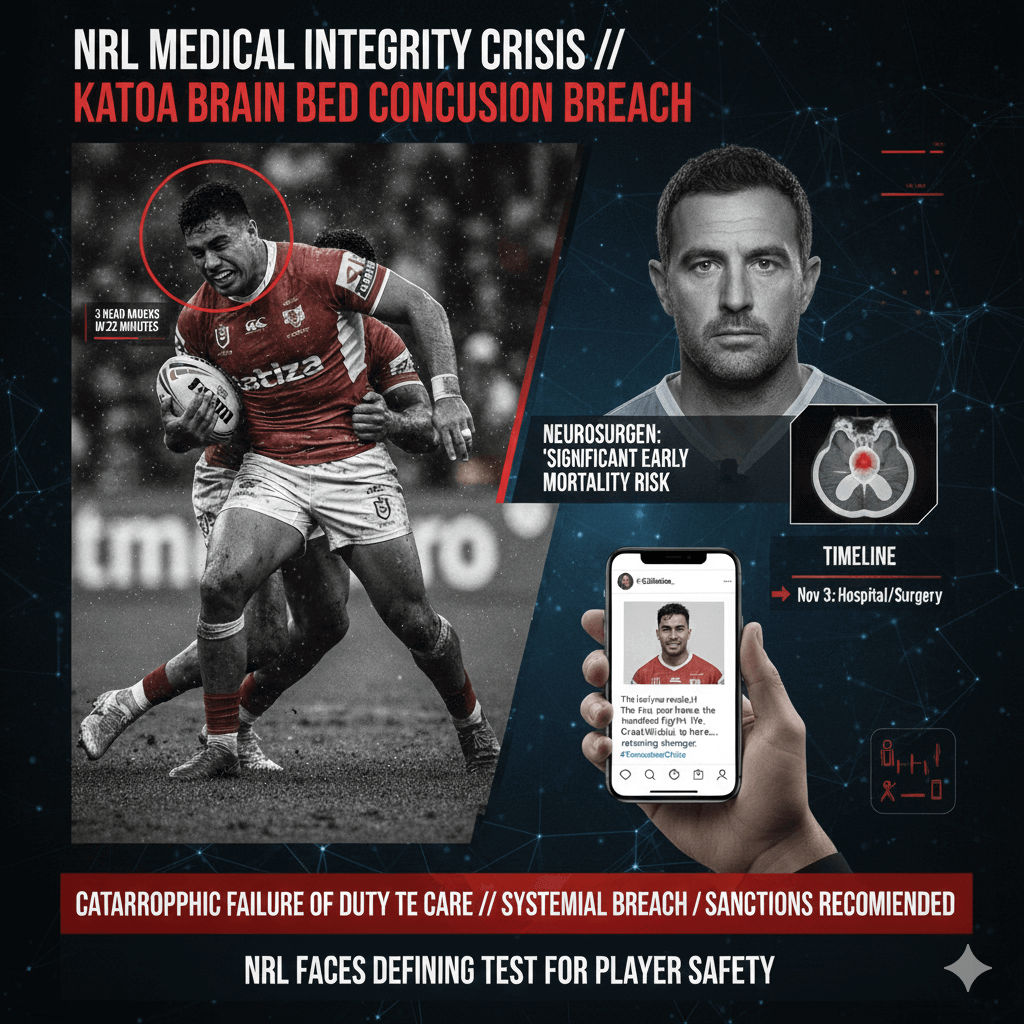
The National Rugby League is confronting one of the most serious medical integrity crises in its modern history after an investigation found multiple concussion protocol failures in the case of Tongan international Eli Katoa, whose on-field injuries progressed into a life-threatening brain bleed requiring emergency surgery.
The incident occurred during the Tonga vs New Zealand Test match on November 2, where Katoa suffered three separate head knocks yet remained in active play. Within hours, he was hospitalized with intracranial bleeding and later underwent neurosurgery. The case has now triggered sweeping disciplinary recommendations against key members of the medical team and reignited concerns over concussion culture in rugby league.
Three Head Knocks, One Undetected Emergency
Match footage and medical records reviewed as part of the joint NRL–Australian Rugby League Commission (ARLC) investigation revealed that Katoa sustained three direct blows to the head within a 22-minute period during the second half.
Independent neurological consultants advised the review panel that each incident displayed observable concussion indicators, including unsteady gait, delayed motor response and disorientation. Despite this, Katoa was neither permanently removed from play nor correctly assessed under Category 1 concussion protocols.
Within hours of the match, Katoa complained of worsening headaches and visual disturbance. He was rushed to hospital where scans revealed a subdural haematoma, requiring urgent surgical intervention.
Systemic Medical Failure Identified
The investigation concluded that the incident represented a multi-layered breakdown of sideline medical governance, including:
- Missed concussion red flags
- Inadequate removal procedures
- Delayed neurological assessment
- Poor communication between doctors and trainers
- Failure to override coaching decisions
A senior ARLC source described the response as “a catastrophic failure of duty of care”, adding that the evidence pointed to systemic issues rather than a single error of judgment.
Severe Sanctions Recommended
Following months of review, the ARLC has recommended unprecedented sanctions:
- Head team doctor: 2-year suspension
- Assistant doctor: 2-year suspension
- Head trainer: 2-year suspension
- Medical assistant: Formal professional warning
If ratified, the bans would extend across:
- NRL club competitions
- Representative matches
- State and junior development pathways
- International rugby league
Legal experts say such career-wide medical bans would be without modern precedent in Australian professional sport.
Katoa’s Medical Condition and Recovery
Katoa underwent successful emergency brain surgery and spent two weeks in intensive care, followed by months of neurological rehabilitation. While his condition has stabilised, specialists confirm he will miss the entire 2026 season and faces a long-term return-to-play assessment under strict neurological clearance protocols.
His treating neurosurgeon confirmed the injury carried a “significant early mortality risk”, adding that timely surgical intervention was decisive in preventing permanent disability.
Player Breaks Silence
In his first public statement since the incident, Katoa posted on Instagram:
“The last few weeks have been the hardest fight of my life. I’m grateful to be here and thankful for my family, my teammates and every doctor who helped save me. I’m focused on recovery and one day returning stronger.”
The post drew widespread support from current and former players, while several NRL captains privately expressed concern over player safety standards at the Test level.
Concussion Culture Under Fire
The case has intensified scrutiny of rugby league’s concussion culture. A recent Rugby League Players Association (RLPA) poll found that 60 per cent of players admitted to training within 48 hours of suffering concussion-like symptoms, despite league protocols advising complete neurological rest.
Sports neurologist Dr Hannah McLeod, who advises multiple professional clubs, described the Katoa incident as a “systemic breakdown born from cultural pressure”.
“Players push through. Coaches push for continuity. Medical staff face subtle influences. This case shows exactly why independent enforcement must be absolute.”
NRL Responds
In a statement, the NRL said it was reviewing all concussion compliance frameworks and would consider further safeguards, including:
- Independent in-game neurologists for internationals
- Automatic removal after multiple head impacts
- Expanded post-match neurological observation protocols
An ARLC spokesperson confirmed new sanction guidelines for medical negligence are also under active consideration.
A Defining Test for Player Safety
Legal analysts say the case may represent a turning point for medical liability in Australian sport, particularly where independent protocols are overridden or ignored.
Professor Mark Ellison, a specialist in sports governance law at UNSW, said:
“This investigation places medical autonomy at the centre of professional sport. If these sanctions proceed, it signals a permanent shift in where legal responsibility truly rests.”
Conclusion
Eli Katoa’s case lays bare the consequences of failing concussion safeguards at the highest level of rugby league. What began as a Test match now stands as one of the most sobering safety scandals in NRL history.
As disciplinary processes move toward their final phase, the league faces a defining question: will concussion policy remain theoretical — or finally become non-negotiable?