Published: 10 December 2025
The New Law and Its Scope
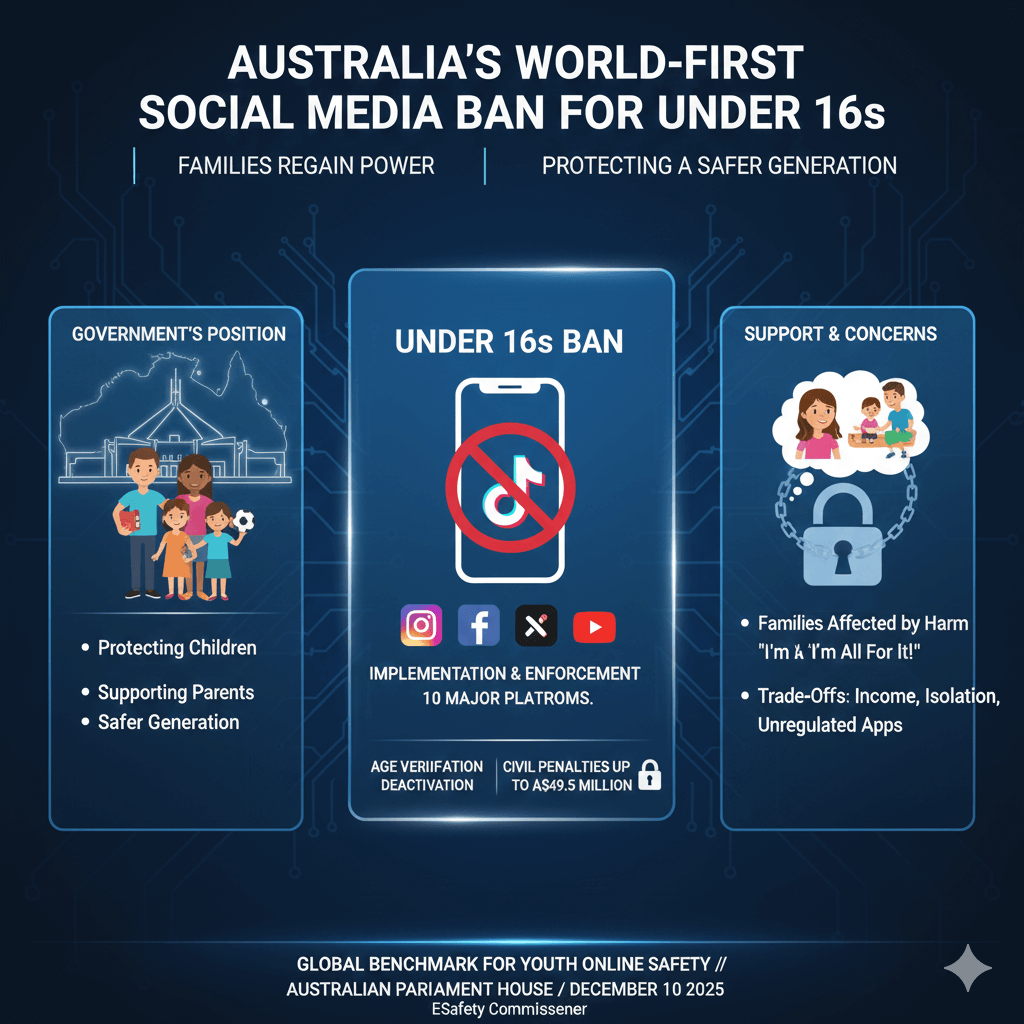
As of 10 December 2025, Australia has implemented a world-first national restriction banning users under the age of 16 from having accounts on 10 major social media platforms — including Facebook, Instagram, TikTok, X (formerly Twitter), YouTube, Snapchat, Reddit, Twitch, Kick and Threads.
Under the legislation, platforms face civil penalties up to A$49.5 million if they fail to take “reasonable steps” to prevent under-16s from retaining or creating accounts. Enforcement is overseen by the eSafety Commissioner.
Implementation & Enforcement Steps
Since the law’s passage, platforms have received official compliance notices. They must report how many under-16 accounts have been identified and closed, and outline their age-verification processes. A first public update is mandated before Christmas.
Early action shows results: more than 200,000 accounts on one major platform have already been deactivated. While authorities anticipate some users will attempt to bypass restrictions — for example with VPNs or false age claims — the eSafety regulator insists that evasions will be progressively uncovered.
Government’s Position: Families Regain Power
Prime Minister Anthony Albanese described the law as a decisive step in returning control to families over their children’s digital lives — shifting responsibility away from tech giants.
“This reform isn’t about punishment — it’s about protecting children, supporting parents, and providing a safer generation,” Albanese said during a press briefing.
He acknowledged the rollout will be difficult and imperfect, but stressed the legislation will “change lives” for many families and set a global benchmark for youth online protection.
Support from Families Affected by Online Harm
Among the most vocal supporters are parents who have lost children to online harms such as sextortion or cyberbullying. They said the new law could help prevent other tragedies and called for greater pre-16 digital literacy and safety education.
A 12-year-old youth advocate, speaking during a national media appearance, welcomed the ban: “If being offline until 16 keeps me and my mates safer and more connected to reality — I’m all for it,” she said.
Concerns and Trade-offs: What Families Might Lose
Not everyone welcomes the change. Families of teenage content creators, influencers and aspiring performers say the ban threatens to wipe out key income-earning platforms and disrupt existing portfolios.
Critics argue the law could push teens toward unregulated or less-safe alternatives, making oversight harder. Some also worry about social isolation and loss of connection, especially in remote or rural areas where digital platforms compensate for limited social access.
The government admits there may be “growing pains,” but maintains the risk is outweighed by potential harms to young people.
Early Reactions from Platforms & Implementation Realities
Major platforms, including those owned by global tech firms, have publicly committed to compliance.
However, transparency documents from early compliance reports — due before Christmas — may reveal wide differences in how companies approach age verification. The law does not mandate a uniform verification standard; instead, platforms must take what the eSafety regulator deems “reasonable steps.”
As the scale of enforcement becomes clear, experts warn of potential loopholes for determined under-16s, especially involving overseas accounts, VPN use, or emerging unregulated apps.
What Next? Monitoring, Education, and Future Options
The government has committed to conducting an independent review within two years to assess the law’s effectiveness and social impact.
Meanwhile, school systems, parenting organisations, and mental health services are calling for expanded digital literacy programs, mental-health support, and offline alternatives to ensure under-16s are not isolated entirely from community and peer connection.
Some policy analysts suggest future amendments may include: mandatory age screening for more platforms, improved mental-health resources, and increased transparency from tech providers on compliance rates.
Final Thought
Australia’s new social media age restrictions mark a bold, world-first attempt to re-balance the power between big tech, government, families and youth. While the law brings promise — protecting under-16s from many online harms — its true success will depend on careful enforcement, ongoing education, and a commitment to support young people through the transition.