Published: 16 December 2025 Sydney
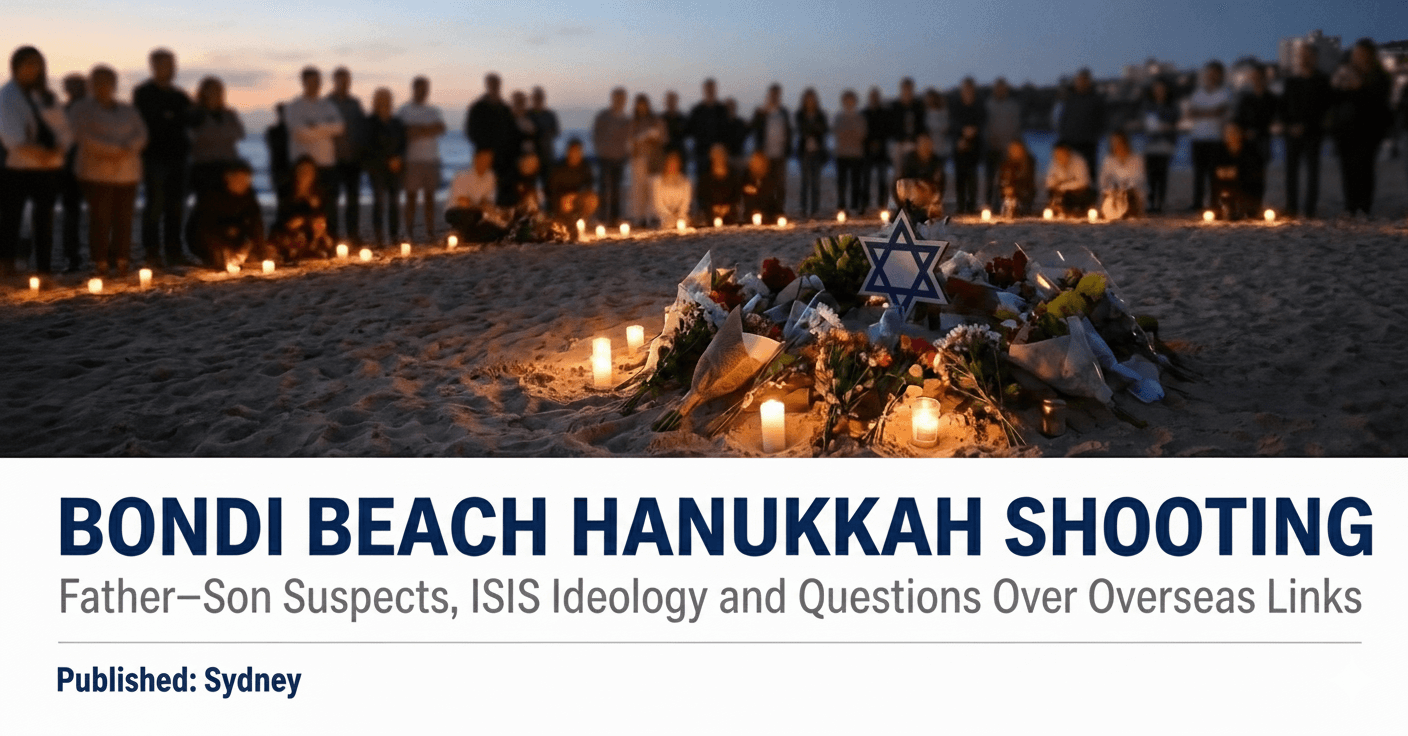
Australia is grappling with the aftermath of the Bondi Beach Hanukkah shooting, an attack that left 15 people dead and has become the country’s deadliest mass shooting in decades. As investigators piece together the motives and movements of the alleged attackers, attention has turned to extremist ideology, overseas travel, and the limits of domestic security monitoring.
The Attack
The shooting occurred during a Hanukkah gathering at Bondi Beach, a public event attended by families and members of Sydney’s Jewish community. Police have confirmed the gathering was specifically targeted, describing the attack as ideologically motivated.
During searches of two vehicles linked to the suspects, officers recovered two homemade flags bearing Islamic State (ISIS) symbols, reinforcing early assessments that the violence was inspired by extremist ideology rather than a personal grievance.
NSW Police Commissioner Karen Webb said the scale and intent of the attack marked a “profoundly confronting moment” for Australia.
Suspects’ Identities and Status
Authorities have identified the suspects as Sajid Akram, 50, an Indian national living in Australia on a resident return visa, and his son Naveed Akram, 24, an Australian citizen.
Police shot and killed the father at the scene after he allegedly continued firing at officers. The son was critically wounded and remains under police guard in hospital.
NSW Police have confirmed there are no outstanding suspects connected to the incident.
Prior Intelligence and Watch-List History
Federal authorities revealed that Naveed Akram had come to the attention of Australian intelligence agencies in 2019 due to associations with individuals of concern. A six-month assessment was conducted at the time.
According to officials, that review concluded there was no ongoing threat, and the younger Akram was not placed on any active watch list.
Prime Minister Anthony Albanese said the attack appeared to be motivated by “Islamic State ideology”, but stressed there was no evidence so far of a broader network or operational cell.
Travel to the Philippines
Investigators have confirmed that both suspects travelled from Sydney to the Philippines on November 1, declaring Davao as their destination. They returned to Australia on November 28, just days before the attack.
The Davao and Mindanao regions have long been associated with Islamist militancy, including the 2017 siege of Marawi, when ISIS-aligned fighters seized parts of the city in a months-long conflict with Philippine forces.
Authorities are examining whether the trip had any relevance to the suspects’ radicalisation, while cautioning that travel alone does not indicate criminal activity.
The Philippine Militant Landscape
Security analysts describe groups such as the Moro Islamic Liberation Front (MILF) and the Moro National Liberation Front (MNLF) as “grandfather movements” — older Islamist organisations that have largely shifted toward political processes.
However, smaller splinter groups continue to operate alongside them. The most notorious is Abu Sayyaf, an ISIS-linked organisation based in the Sulu archipelago, known for kidnappings, bombings and beheadings. Abu Sayyaf has been designated a terrorist organisation by multiple countries since 1997.
Current Strength and Ongoing Risks
Counter-terrorism experts say groups like Abu Sayyaf have been significantly weakened by years of sustained military pressure, improved regional governance, and former-fighter reintegration programs.
Large-scale attacks are now less frequent and smaller in scale, but analysts warn the main risk comes from residual cells, lone actors, and ideological sympathisers — particularly if security conditions deteriorate.
This mirrors trends seen in other countries, where extremist violence increasingly takes the form of self-directed attacks inspired online, rather than centrally planned operations.
Training and “Terror Camp” Questions
Philippine security officials say they have no evidence of foreign militants training in organised camps in the south of the country in recent years.
Experts argue that formal “terror camps” are highly unlikely for foreign visitors, especially given heightened surveillance. A more plausible scenario, they say, would involve informal contact or ad-hoc weapons familiarisation with former fighters rather than structured training.
Australian authorities have not confirmed that the suspects undertook any form of militant training overseas.
Local Community Shock and Police Raids
In the days following the attack, police executed raids on an Airbnb property in Campsie and a house in Bonnyrigg, locations linked to the suspects.
Neighbours described the family as quiet and unremarkable, saying there were no obvious signs of extremism or violence.
Public vigils and memorials have been held at Bondi Beach, with thousands gathering to honour the victims and stand in solidarity with the Jewish community.
A Nation Reflects
As investigations continue, the Bondi Beach shooting has prompted renewed debate about radicalisation pathways, community safety, and the challenges of identifying lone-actor threats before violence occurs.
Federal and state authorities say reviews of intelligence-sharing and threat-assessment processes are underway, while emphasising that Australia’s security agencies disrupted multiple plots in recent years.
For now, the focus remains on supporting victims’ families — and ensuring such an attack is never repeated.