Published: 25 December 2025
Carlos Alcaraz’s decision to end his long-running coaching partnership with former world No.1 Juan Carlos Ferrero has sent shockwaves through professional tennis, closing one of the sport’s most successful modern player–coach relationships.
The split, confirmed in December 2025, was not a mutual separation, despite careful public language. Instead, multiple reports from Spanish and international tennis media indicate Ferrero was dismissed following a breakdown in contract negotiations and growing philosophical differences over how Alcaraz’s career should be managed.
A Breakup Framed Politely — But Not Evenly
Ferrero confirmed the end of the partnership in a brief statement, saying he “would have liked to continue” working with Alcaraz — a remark widely interpreted as signalling that the decision was not his.
Spanish outlets including Marca and AS reported that renewal talks collapsed just two days before the split, with no agreement reached on new contractual terms. Sources cited by those publications describe the decision as unilateral, driven by Alcaraz’s camp rather than a shared conclusion.
One of Tennis’s Most Successful Partnerships
The Alcaraz–Ferrero collaboration delivered extraordinary results in a short time:
- Six Grand Slam titles
- World No.1 ranking
- Multiple Masters and ATP titles
- Ferrero named ATP Coach of the Year
Ferrero, who runs the Equelite Academy in Villena, was credited with building the discipline, physical conditioning and tactical structure that underpinned Alcaraz’s explosive rise.
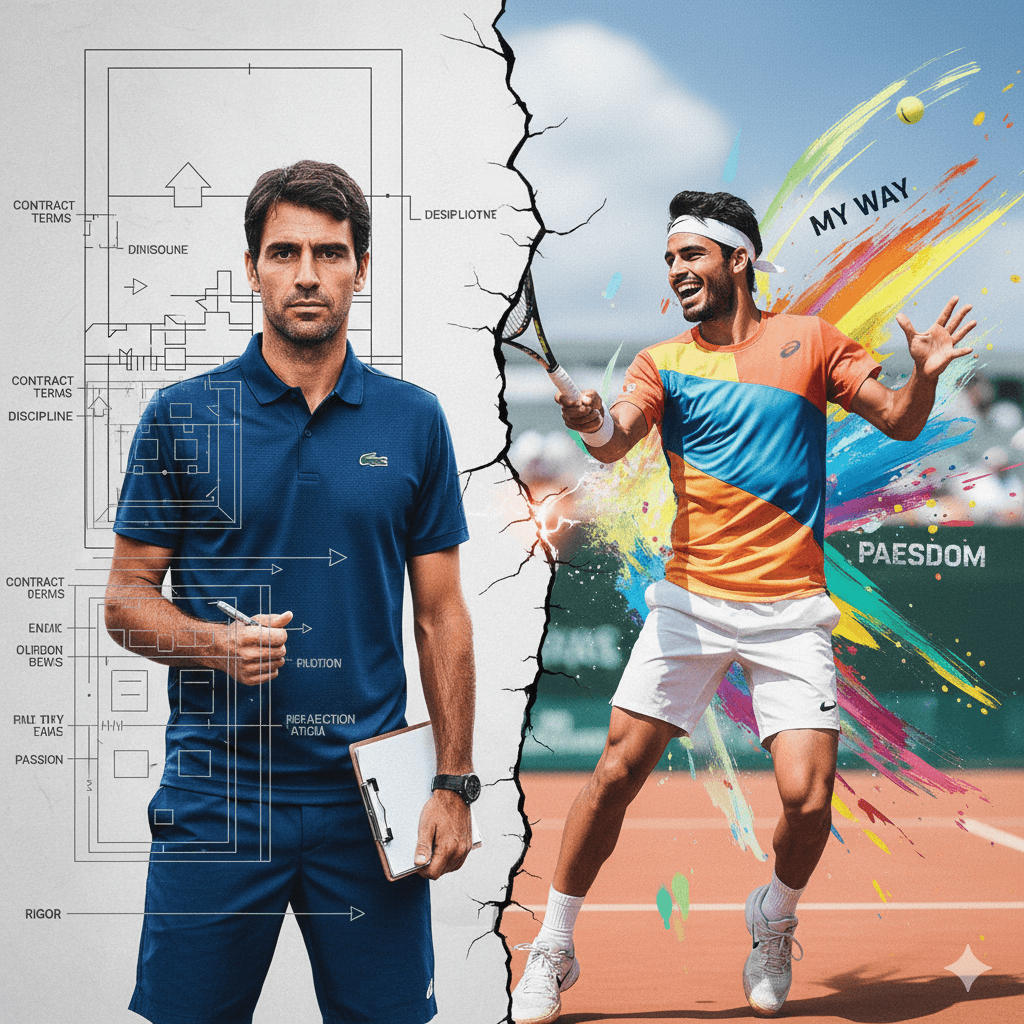
Clashing Philosophies: Structure vs “My Way”
At the heart of the separation was a growing philosophical divide.
Ferrero is known for a rigorous, highly structured approach, emphasising recovery, scheduling discipline and off-court restraint. Alcaraz, by contrast, has increasingly spoken about wanting to enjoy his career, value personal freedom and follow what he has repeatedly called “my way”.
Former Brazilian player Fernando Meligeni described the conflict as a classic power struggle between coach and superstar.
“When a player becomes world No.1, the question is simple: who adapts to whom?” Meligeni said in commentary reported by Spanish media. “In this case, the player won.”
Contract Talks and an Ultimatum
According to multiple reports, negotiations for a renewed coaching contract broke down after Alcaraz’s camp allegedly presented Ferrero with a 48-hour ultimatum to accept revised terms, with no room for renegotiation.
Insiders described the situation as “scandalous”, noting Ferrero’s long-term role in shaping Alcaraz’s career and questioning the abrupt nature of the exit.
Family Influence and Team Dynamics
Another critical factor was the increasing influence of Carlos Alcaraz Sr, who plays a central role in his son’s career decisions. Spanish reporting has consistently noted tension between Ferrero and Alcaraz’s father over training locations, scheduling and authority within the team.
Alcaraz’s father and brother are embedded in the inner circle, a structure that aligns with the player’s “My Way” philosophy but, according to analysts, diluted Ferrero’s authority as head coach.
Flashpoints That Weakened the Relationship
Several incidents are cited as turning points:
- South American tour dispute (2023): Ferrero skipped the tour, delegating responsibilities to Antonio Martínez Cascales — a move that reportedly angered Alcaraz’s father.
- Training base disagreements: Ferrero preferred Villena; Alcaraz increasingly favoured El Palmar, where his family had greater control.
While none of these issues alone caused the split, together they eroded trust.
A Gradual Shift Away From Ferrero
By late 2025, Ferrero’s role had already diminished. Assistant coach Samuel López took on a larger on-court presence and was credited with tactical refinements, including changes to Alcaraz’s serve.
Ferrero travelled less frequently, leading many within the sport to view López as the de facto successor even before the official announcement.
What Comes Next for Alcaraz
No permanent replacement has been confirmed, but López is expected to coach Alcaraz at the Australian Open 2026. The tournament remains a relative weak spot for the Spaniard, who has yet to reach a semi-final in Melbourne despite his dominance elsewhere.
As the world No.1 enters the next phase of his career, the breakup raises a broader question facing all elite athletes: how long structure and authority can survive once power fully shifts to the player.