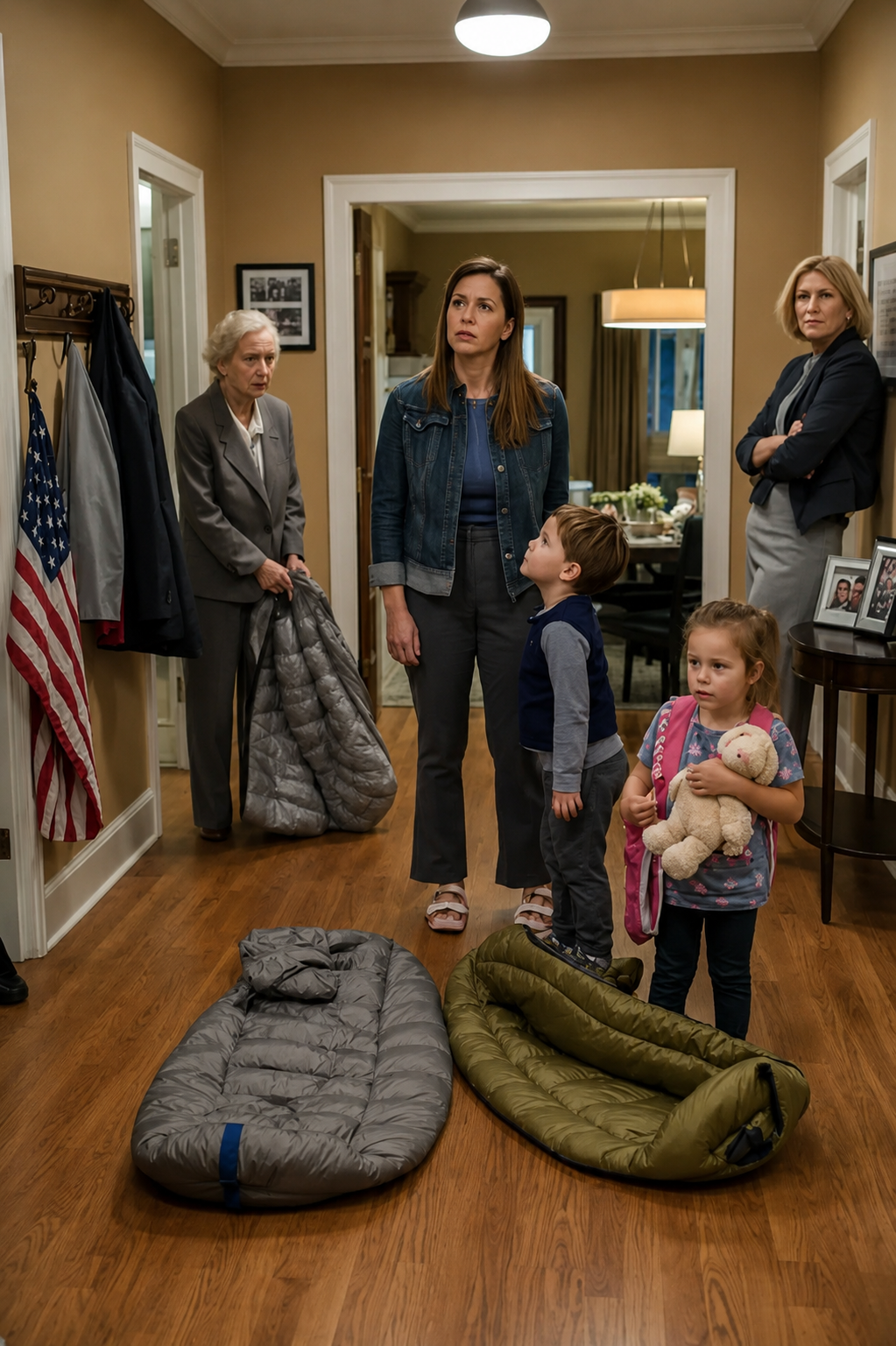
The moment my mother tossed two old sleeping bags toward my children, something inside me finally changed. It wasn’t really about where they would sleep that night. It was the realization that I had spent years sacrificing for a family that seemed to value me only when I was solving problems, paying bills, or carrying burdens no one else wanted to handle.
My husband Ryan, our son Owen, our daughter Ellie, and I had driven from Rochester to my mother’s house for Thanksgiving. Like every year, I arrived carrying more than luggage. I brought a homemade pumpkin pie using my late father’s treasured recipe and a new tablecloth I had purchased after hearing my mother mention that her old one was stained. I never thought much about the cost or effort. Contributing had become second nature to me.
When we arrived, it was immediately clear that my sister Ashley and her children had already settled in comfortably. Their belongings filled the guest room, while our coats found temporary space elsewhere. Throughout dinner, everything appeared normal. We shared a meal, exchanged conversation, and followed familiar holiday routines. Yet, as always, much of the unseen work fell to me while Ashley was excused from responsibilities because she was supposedly having a difficult time.
Later that evening, as the children grew tired, I asked my mother where Owen and Ellie would sleep. Instead of discussing arrangements, she casually explained that Ashley’s children were already comfortable in the guest room and wouldn’t be moved. Then she pulled two old sleeping bags from a closet and tossed them toward the living room floor, suggesting my children would enjoy the experience as an adventure.
Owen quietly studied my reaction, while Ellie innocently hugged one of the sleeping bags. My sister stood nearby, clearly amused by the situation. In that moment, I recognized a pattern I had ignored for years. Growing up, Ashley was always protected and accommodated, while I was praised for being “strong enough” to manage disappointment. What I was witnessing wasn’t simply about sleeping arrangements—it was the same lesson being passed down to my own children.
Rather than arguing, I calmly told my children to gather their belongings because we were leaving. Ryan immediately understood and helped pack without asking questions. As we drove away, my mother dismissed my decision as an overreaction, insisting it was only one night. But for me, it represented far more than a single evening. It was the latest example of a lifetime spent being expected to give while receiving little acknowledgment in return.
During the drive home, I reflected on the years following my father’s death. Four years earlier, my mother had struggled financially after losing him. Wanting to honor my father’s wish to care for the family, I quietly stepped in. I began paying her mortgage, covering insurance costs, financing major home repairs, helping with renovations, and even paying for my niece’s extracurricular activities. Month after month, the expenses accumulated while my contributions remained largely invisible.
My husband had questioned the arrangement from the beginning, reminding me that I was supposed to be my mother’s daughter, not her financial support system. At the time, I convinced myself it was my responsibility. Over the years, however, the assistance became expected rather than appreciated. What started as temporary help evolved into an unspoken obligation.
The morning after Thanksgiving, I made a decision. Sitting at my kitchen table, I canceled every recurring payment I had been making. Mortgage assistance, insurance premiums, tuition payments, and planned home projects all came to an end. The monthly financial burden I had been carrying disappeared with a few clicks, and for the first time in years, I felt a sense of freedom.
Predictably, phone calls followed. My mother initially assumed the missing payments were a mistake. My sister wondered whether I had forgotten to update a credit card. Neither seemed to realize the extent of what I had been providing. What hurt most was not the financial dependence—it was the assumption that my contributions would continue indefinitely without recognition.
Eventually, I agreed to meet my mother for coffee. Armed with years of records and statements, I showed her exactly how much support I had provided. The total exceeded $120,000. As she reviewed the numbers, she finally saw what had been hidden behind years of automatic payments and quiet sacrifices.
For the first time, I explained how deeply the imbalance had affected me. I reminded her that while Ashley received accommodations, praise, and protection, I was expected to solve problems and absorb difficulties without complaint. The sleeping bags had simply exposed a truth that had existed for decades.
I assured her I did not want to see her lose the family home, but I also made it clear that I would no longer carry the responsibility alone. Other solutions existed, including contributions from Ashley or changes to her living situation. Most importantly, I demanded something I should never have had to ask for: respect for my family and equal treatment for my children.
As our conversation ended, my mother finally thanked me for everything I had done. It was the first genuine acknowledgment I had received after years of support.
That weekend, I bought my children new sleeping bags—not because they needed them, but because I wanted to transform a painful memory into something positive. We made plans for a family camping trip, one focused entirely on our own happiness rather than meeting someone else’s expectations.
Sitting on our porch with hot chocolate, watching my children laugh and count marshmallows, I realized something important. For years, I thought I was responsible for holding my mother’s household together. In reality, the home I needed to care for was the one I had built with Ryan and our children.
My father often said that a house doesn’t support itself. He was right. But I finally understood that the “house” he meant wasn’t necessarily a building. Sometimes it’s the life you create, the family you nurture, and the boundaries you establish to protect what truly matters.
And for the first time in years, I was building in the right direction.