My name is Jess Caldwell. I’m thirty years old, an Army captain, and for five years my father-in-law never seemed to think either of those facts mattered.
Gerald Caldwell wore his Marine identity like armor. The front porch flew Marine Corps flags. A faded Corps banner framed the front door. Unit photos lined the hallway in perfect rows, each one carefully positioned as if inspected before every family gathering.
Every story Gerald told somehow circled back to his service.
The first time I met him, he shook my hand, looked me over, and said, “Army, huh? Well, somebody has to handle the paperwork.”
Everyone laughed.
Looking back, that moment told me exactly what the next five years would be like.
Tyler and I married in 2020 during the height of uncertainty. The ceremony was small—just family and close friends gathered in a backyard.
My mother arrived straight from a shift at the VA hospital, still wearing scrubs beneath her cardigan because she refused to miss her daughter’s wedding.
Thanksgiving later that year was my first real introduction to Gerald’s world.
The rules were invisible but obvious.
The men gathered in the living room.
The women worked in the kitchen.
And Gerald sat at the center of everything, holding court from his recliner while everyone listened.
Every holiday afterward followed the same pattern.
He asked Tyler about work.
He asked my brother-in-law Marcus about work.
He asked his Marine buddies about work.
He asked former sailors, neighbors, and old friends about work.
But when it came to me, he rarely asked anything at all.
If my job came up, he described me as someone who “worked on base somewhere.” Sometimes I was a “desk girl.” Sometimes a “paper pusher.”
And every time, people accepted that explanation because I never corrected him.
Not fully, anyway.
I work in military intelligence.
A significant portion of what I do is classified.
The nature of the job means you learn to stay quiet about the things that matter most. The operations, assessments, deployments, and briefings I’m proudest of are often the very things I cannot discuss over burgers and potato salad.
So Gerald filled the silence himself.
He created a version of me that fit his assumptions.
And because I never turned family dinners into security briefings, that version remained unchallenged.
The Army, fortunately, never shared his opinion.
I commissioned through ROTC.
I earned captain ahead of many of my peers.
I deployed twice.
I briefed senior officers who cared about one thing only: whether I knew my job.
I did.
Every time.
But competence means very little to someone who has already decided who you are.
By 2025, Gerald’s youngest son, Colton, had been in the Marines for about eighteen months.
To Gerald, it was as though the family lineage had finally returned to its proper course.
Every conversation became about Colton.
Every barbecue became a celebration of Colton.
Every gathering eventually led back to the same phrase.
“A real one in the family.”
He never directed the words at me.
He didn’t need to.
I heard the meaning anyway.
On the Fourth of July, Tyler and I drove down to Gerald’s house outside Jacksonville.
The heat hit us the moment we stepped out of the car.
Flags lined the driveway.
Country music drifted across the yard.
The smell of burgers and charcoal hung in the air.
Retired Marines occupied lawn chairs arranged around Gerald like he was still commanding a unit.
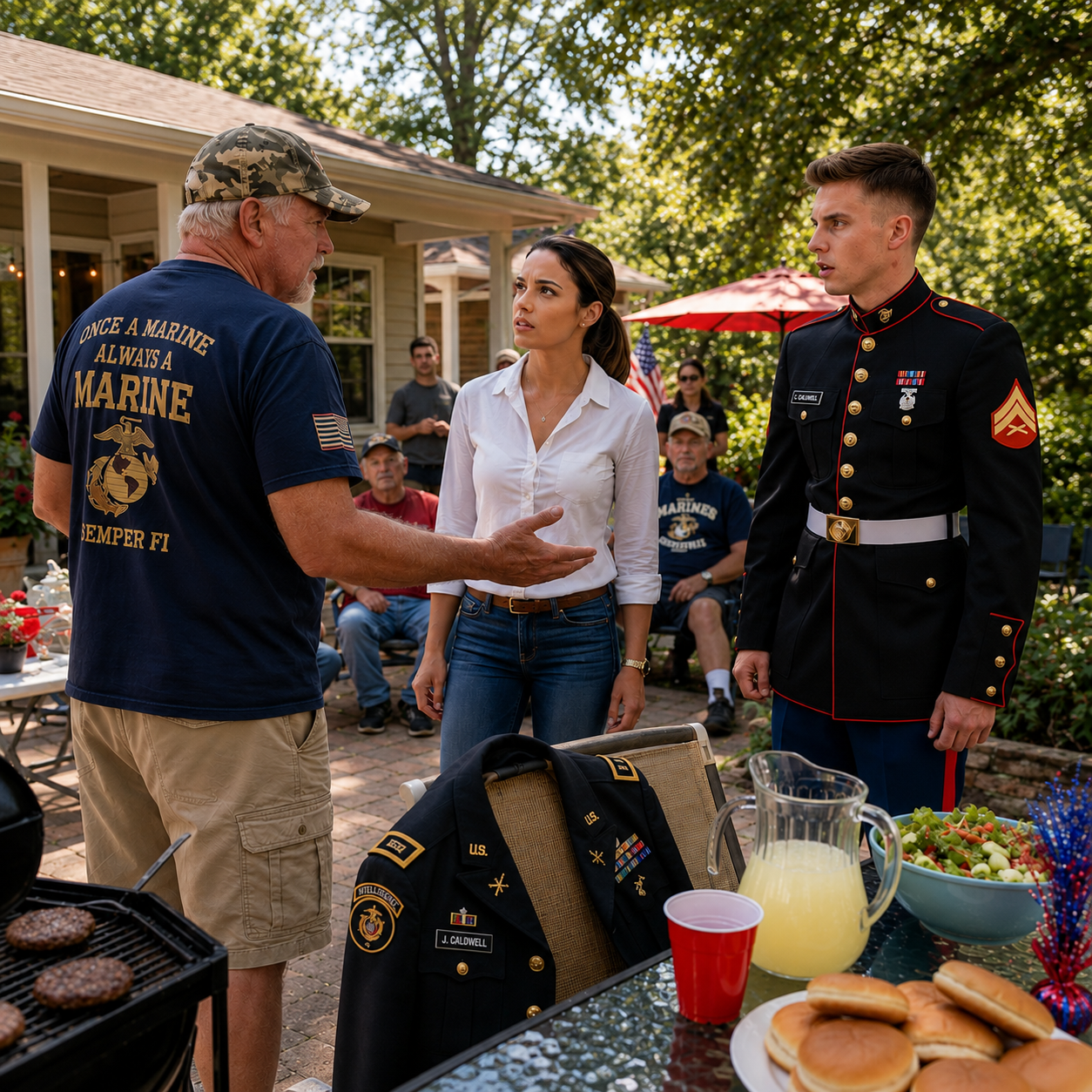
Earlier that day I had attended a joint training meeting at Fort Liberty. Tyler carried my Army service jacket inside while we unloaded our things.
Without thinking, I draped it over the back of a patio chair.
I never intended to make a statement.
It was just a jacket.
Or so I thought.
I started walking toward the grill to greet Gerald’s neighbor Rick, one of the few people there who consistently treated me like a professional.
Before I reached him, Gerald stepped into my path.
Beer in one hand.
Tongs in the other.
That familiar grin already in place.
“The men are talking, sweetheart,” he said. “Go help with the salad.”
Several of his friends laughed.
Not cruelly.
Almost worse than cruelly.
Like they had heard the joke so many times it had become tradition.
I looked at him for a moment.
Then I turned around.
I poured myself a glass of lemonade and sat alone at the patio table.
Behind me, my jacket hung over the chair.
The silver captain’s bars caught the sunlight.
I spent the next twenty minutes listening to distant conversations, watching a mockingbird move through the branches of an oak tree, and reminding myself that patience was a skill I had spent years developing.
Then Colton arrived.
His truck rolled into the driveway, and moments later he rounded the side of the house wearing a crisp Marine uniform.
Gerald practically sprinted across the yard to greet him.
The retired Marines sat up straighter.
Conversations shifted.
Attention followed him naturally.
“There he is,” Gerald announced proudly.
“A real Marine.”
Colton laughed, shook hands, accepted congratulations, grabbed a plate of food, and eventually headed toward the patio.
Toward me.
His smile faded the moment he noticed my jacket.
I watched recognition unfold across his face.
First the captain’s bars.
Then the insignia.
Then realization.
Complete and immediate.
He looked at the jacket.
Then at me.
Then back again.
“Jess,” he said quietly.
His tone had changed completely.
“Were you the Army intelligence captain who briefed our exercise at Lejeune this spring?”
I simply met his eyes.
I didn’t answer.
I didn’t need to.
The scrape of his chair against the concrete cut through the yard.
Colton stood.
Then he turned toward the grill.
Toward his father.
“Dad,” he called across the gathering. “Do you have any idea who she is?”
The entire backyard seemed to freeze.
Gerald looked over.
“What are you talking about?”
“I’m asking if you know what Jess actually does.”
Gerald shrugged.
“She’s Tyler’s wife. Works on base somewhere.”
The words landed heavily.
For the first time, everyone heard them differently.
“She briefed my unit,” Colton said.
Silence.
“She designed part of our exercise. Coordinated the intelligence picture. Briefed sixty Marines and two lieutenant colonels.”
Now everyone was looking at me.
Not politely.
Not casually.
Actually looking.
One of Gerald’s retired Marine friends, Roy, stepped closer and studied the jacket.
“What unit?” he asked.
I told him.
His expression changed instantly.
He turned back toward Gerald.
“Gerald,” he said quietly, “I know that unit.”
That was when Gerald set down the tongs.
Anyone who knew him understood the significance of that.
Gerald never set down the tongs.
“You’re intelligence?” he asked.
“I am.”
“You briefed Colton’s unit?”
“Among others.”
For the first time since I’d known him, Gerald seemed unsure what to say next.
Roy filled the silence.
“When our unit received intelligence support overseas, everything changed,” he said. “How we planned. How we moved. How we understood the battlefield.”
He nodded toward me.
“That work matters.”
Gerald looked at me differently now.
Not as his son’s wife.
Not as background noise.
Not as the woman he had spent years overlooking.
As a fellow service member.
“You’ve deployed?” he asked.
“Twice.”
“What did you see?”
I smiled slightly.
“Most of that isn’t something I can discuss.”
To his credit, he immediately understood.
He simply nodded.
Then Colton told the story.
He described the exercise.
The planning.
The terrain analysis.
The intelligence briefings.
The questions from senior officers.
The answers.
The confidence.
The expertise.
When he finished, the yard remained silent.
Finally Gerald looked at me.
“I owe you an apology.”
No excuses.
No qualifications.
Just the truth.
“The comments,” he said. “The assumptions. All of it.”
I nodded.
“You do.”
A faint smile touched the corner of his mouth.
“You’re not making this easy.”
“I lived through five years of it,” I replied.
That earned a genuine laugh.
The first one we’d ever shared.
The afternoon changed after that.
People stopped talking around me and started talking to me.
Roy asked real questions.
Hector shared stories from his own deployments.
Colton stayed at the table.
Even Gerald eventually pulled up a chair and sat with us instead of presiding from the grill.
Later, without a word, he brought me the best burger from the center of the grill and placed it in front of me.
It was a small gesture.
But after five years, it meant something.
That evening, after the fireworks faded and the guests began leaving, I sat alone on the porch.
My jacket rested across my arm.
Gerald stepped outside carrying two beers.
He handed one to me and leaned against the railing.
For a while neither of us spoke.
Finally he broke the silence.
“Intelligence work,” he said. “I never really understood what that looked like.”
“Most people don’t.”
He nodded.
Then he said something I’ll never forget.
“Your people keep our people alive.”
“That’s the goal,” I replied.
He stared out across the dark yard for a moment.
Then he said quietly, “I’ll do better.”
Not a speech.
Not a dramatic apology.
Just a promise.
Five years of being dismissed didn’t disappear overnight.
Things like that never do.
But something changed that day.
Not because I argued.
Not because I demanded recognition.
And not because I finally explained what I did.
The truth simply became impossible to ignore.
A captain’s bars.
An intelligence insignia.
And a young Marine willing to tell his father exactly who had earned his respect.
For the first time since joining the family, Gerald looked at me and saw the person who had been there all along.
And sometimes, after years of being invisible, being seen is enough.