Published: 12 December 2025 | Sydney
Just days after Australia enacted its world-first nationwide ban preventing under-16s from accessing major social media platforms, children are already discovering creative — and surprisingly effective — ways to get around the new restrictions. The rapid workaround attempts have turned the reform into a real-time experiment in age-verification technology, digital policy, and parental cooperation.
Kids Quickly Find Ways to Bypass the Ban
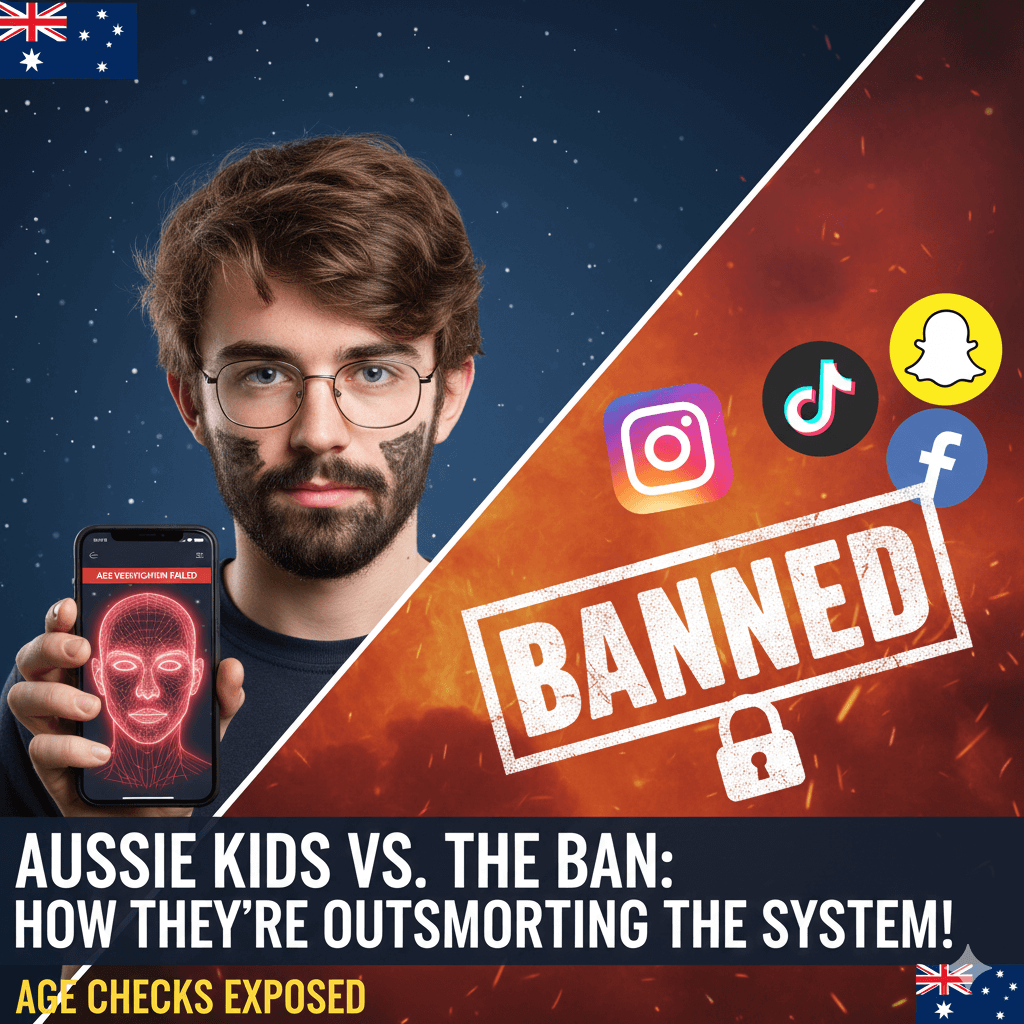
Across Australia, under-16s are tricking facial age-estimation tools using surprisingly simple methods: exaggerated facial expressions, heavy makeup, drawn-on beards, or even asking parents to momentarily appear on camera for age checks.
Parents report instances where 11- and 12-year-olds have been misclassified as 17 or 18, unintentionally giving them access to content aimed at older teens and young adults.
Others have bypassed the restrictions by logging in through older siblings’ or parents’ phones, switching accounts, or using devices where detection tools have not yet rolled out.
Tech Flaws and Enforcement Gaps Exposed
Age-verification systems — including facial recognition, behavioural data and platform-level metadata — have shown mixed accuracy during the first days of enforcement.
Under the new rules, platforms like TikTok, Instagram, Snapchat and YouTube must block users under 16, but the rollout has highlighted:
- Facial-age estimators misreading younger faces
- Children remaining active on platforms such as Snapchat and TikTok
- Shared family logins that bypass all checks
- Parents deliberately helping kids stay online
Online-safety advocates say these loopholes were predictable, noting that children are often “more tech-adaptive” than the systems designed to protect them.
The Law Behind the Ban — and Why It Matters Globally
The under-16 ban covers 10 major digital platforms, including:
- YouTube
- TikTok
- Snapchat
- X
- Threads
- Twitch
- Kick
Under the legislation, companies must take “reasonable steps” to identify and disable under-16 accounts or face penalties of up to A$49.5 million.
All relevant platforms have confirmed they will comply — at least in principle — although many have raised concerns about accuracy and privacy behind closed doors.
Australia’s move is being closely watched internationally, with several governments viewing the ban as an important test of tech governance.
The rollout is drawing attention from policymakers in Denmark, Norway, France, Spain, Malaysia and New Zealand, all exploring models to limit youth social media use or reduce algorithmic harms.
If successful, experts say Australia’s policy could become a template for global youth-safety regulation, particularly as countries grapple with mental-health crises linked to smartphone and social-media overuse.
Strong Public Support — But Growing Controversy
Polling indicates that around three-quarters of Australians support the ban, citing concerns about:
- Mental-health deterioration
- Cyberbullying
- Sexual exploitation
- Algorithmic addiction
- Exposure to pornography
However, parents, academics and civil-liberties groups warn that the rollout is already revealing major practical and ethical challenges.
Critics question:
- Whether children will migrate to less-regulated spaces
- Whether facial-age checks invade privacy
- If the law can realistically be enforced
- Whether the ban reduces or increases digital risk
Expert and Academic Commentary
Child-development researchers say the ban places significant pressure on tech companies to finally design platforms that are age-appropriate and safe by default, rather than relying on parental policing.
Dr Karen Ripley, a Melbourne-based digital childhood expert, told media:
“Age-gating alone won’t fix the root issue. Teens will always find ways around restrictions unless platforms are fundamentally designed with their wellbeing in mind.”
Psychologists agree that the policy could lead to healthier online habits — but only if paired with redesigned social platforms that limit algorithmic manipulation, addictive loops and harmful content.
Others warn that the ban risks becoming a cat-and-mouse game, with technically savvy teens consistently staying a step ahead of detection tools.
A National Experiment With Global Stakes
Australia’s under-16 social media ban is only days old, yet it has already become a revealing stress-test of the tension between policy ambitions, parenting realities, youth behaviour, and technological limitations.
While supporters believe the law will save lives, critics argue that genuine safety will require deeper reform of how social media operates — not just who can log in.
The coming months, and the compliance data from the platforms, will determine whether Australia’s world-first ban becomes a global blueprint or a digital-age cautionary tale.