
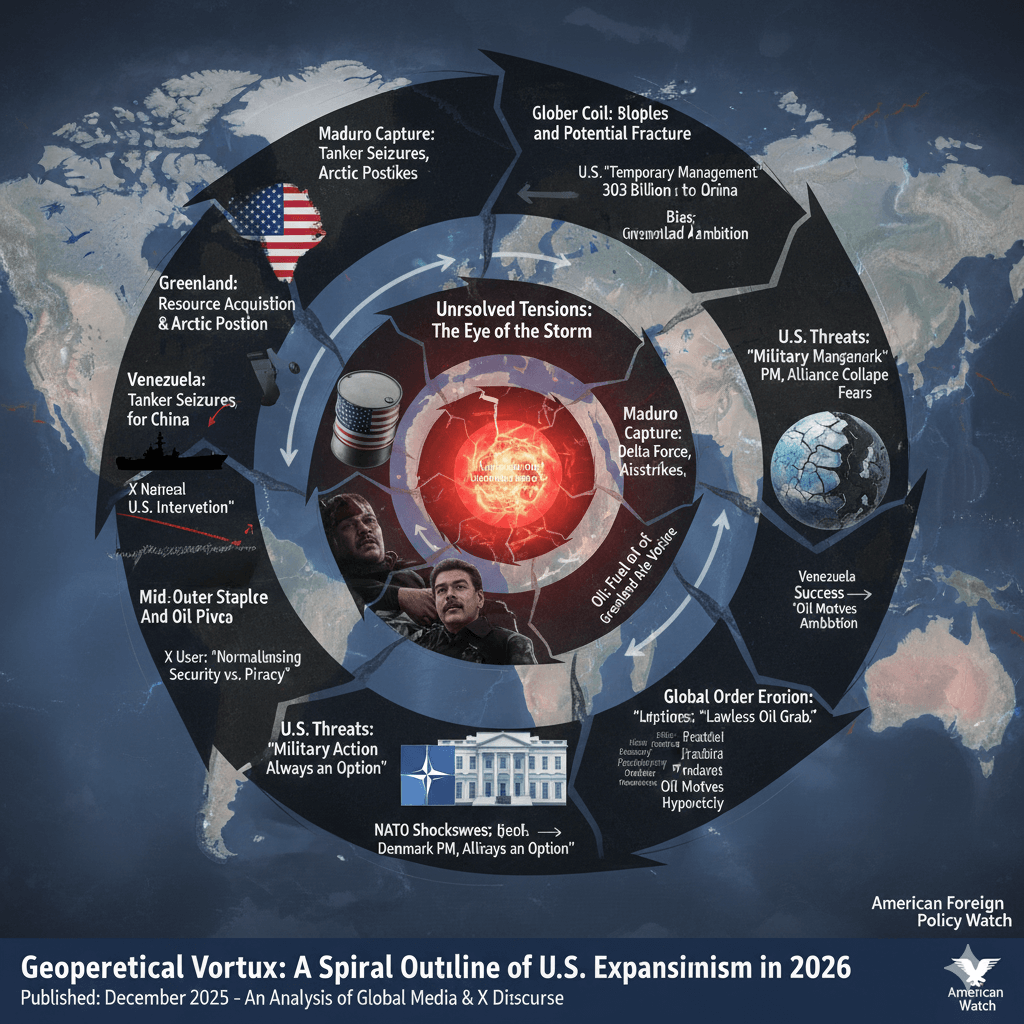
Each “coil” builds tension, incorporating interconnected news analyses from diverse sources (U.S., European, Venezuelan perspectives) to represent balanced stakeholder views. The spiral allows readers to “unwind” the narrative non-linearly, starting from any coil for modular reading, while citations provide evidentiary anchors. Analysis draws from recent reports, highlighting biases: U.S. sources emphasise “national security,” European ones decry “imperialism,” and Venezuelan voices label it “piracy.”
Historical Context and Early Warnings
Donald Trump’s longstanding interest in Greenland has resurfaced, framed as a strategic move for resource acquisition, including rare earth minerals and an advantageous Arctic position. Danish intelligence has listed the U.S. as a “potential security concern,” citing explicit threats of annexation. Simultaneously, the U.S. seized Venezuelan oil tankers, such as the Panama-flagged Centuries carrying approximately 1.8-1.9 million barrels of Merey crude bound for China, signalling an escalation in economic warfare against Nicolás Maduro’s regime. Discussions on X have highlighted this as “normalising” U.S. intervention in the hemisphere, with users pointing to a pattern of aggressive resource pursuits.
Analysis
Sources like Reuters portray these tanker seizures as strategically targeting sanctioned vessels, assuming a U.S. moral high ground against illicit trade. In contrast, Venezuelan perspectives decry it as “criminal piracy,” underscoring a bias toward sovereignty defence versus U.S. anti-narcotics narratives. This outer coil establishes oil as the vortex’s primary fuel, positioning Greenland as the logical next target in a broader expansionist strategy.
Key Stakeholder Reactions
Denmark has appointed special envoys in response, while the U.S. named Jeff Landry as its envoy, invoking a “300-year lineage” for legitimacy—a claim dismissed in analyses as “colonial cosplay.” House Democrats have condemned the emerging rifts with NATO allies, warning of strained transatlantic relations.
Maduro’s Seizure and Immediate Aftermath
U.S. special forces, including Delta Force, executed a rapid 30-minute operation to capture Maduro and his wife in Caracas, accompanied by airstrikes on key sites. Trump subsequently announced U.S. “temporary management” of Venezuela, unlocking access to the world’s largest proven oil reserves at 303 billion barrels. The deal involves Venezuela turning over 30-50 million barrels at market prices, redirecting supplies previously bound for China.
Analysis
Outlets like NPR and Reuters frame this as a “win” for U.S. energy security, celebrating the potential for reduced dependence on foreign adversaries. However, Venezuelan officials have labelled it a “kidnapping” aimed at stealing national reserves, with posts linking it to earlier tanker interdictions as evidence of a “squeezing” strategy rather than full-scale war. Biases are evident: Pro-U.S. sources hail it as “regime change,” while critics point to practical barriers like sabotaged infrastructure hindering quick exploitation. This pivot energises the vortex, emboldening U.S. ambitions toward Greenland.
Key Stakeholder Reactions
In interviews, Maduro warned of a U.S. “war for oil,” while opposition figures celebrated the move; the EU, however, has called for restraint amid fears of broader instability. U.S. companies like Exxon are eyeing asset recovery, positioning themselves for potential windfalls.
Greenland Escalation
U.S. Threats Materialise
The White House has declared military action “always an option” for acquiring Greenland, citing national security imperatives bolstered by the Venezuela success. Trump has refused to rule out force, echoing his 2019 rhetoric about “purchasing” the territory.
Analysis
BBC, Al Jazeera, and Guardian reports unanimously describe this as sending “shockwaves” through NATO, with Denmark’s Prime Minister warning of potential alliance collapse. Threads amplify concerns over “resource theft,” noting 85% opposition among Greenlanders and the U.S.’s existing access to Thule Air Base. Biases surface: U.S. outlets stress exploratory “options” without endorsing force, whereas European think tanks advocate leveraging against what they term U.S. “annexation.” The “success” in Venezuela spirals directly into Greenland, heightening risks of broader conflict.
Key Stakeholder Reactions
European allies have rallied behind Denmark, with Greenlanders demanding respect for their self-governance amid the threats. X users debate the feasibility of a U.S. “walk-in” without significant resistance, questioning the practicality of enforcement.
Global Ripples and Potential Fracture
NATO and International Fallout
Fears of NATO’s “end” dominate discourse, with experts predicting a transatlantic nadir if tensions escalate further. Links to broader U.S. “rogue” actions compound the unease.
Analysis
Analyses dissect the Maduro operation as a precedent-setting “lawless oil grab,” potentially eroding the global order. X analyses frame it as “predatory,” with figures tying it to oil motives. A balanced view acknowledges U.S. gains in energy independence but highlights alienation of allies, risking NATO fracture over “annexation” pursuits. The vortex’s core exposes hypocrisy—the U.S. condemns invasions elsewhere yet pursues its own territorial ambitions.
Key Stakeholder Reactions
Reports warn of persistent infrastructure barriers in Venezuela complicating oil extraction; global discourse questions U.S. ethics, with some praising the potential “energy boom.” Calls for congressional oversight remain notably absent, raising concerns about unchecked executive power.
Unresolved Tensions (The Eye of the Storm – Future Projections)
Synthesis and Open Questions
The spiral converges on a revival of the U.S. “Monroe Doctrine,” linking oil grabs to territorial ambitions. Will NATO survive intact? Could Greenland trigger a wider conflict? Analyses from all sources indicate high escalation risks, with oil serving as the binding force.
Final Analysis
Pro-U.S. bias in American media downplays imperialism, while international sources emphasise sovereignty erosion. X amplifies public outrage, predicting “new international norms” of force. This structure underscores the interconnected, intensifying nature of events, urging diplomatic de-escalation to avert further global instability.