Published: 25 November 2025
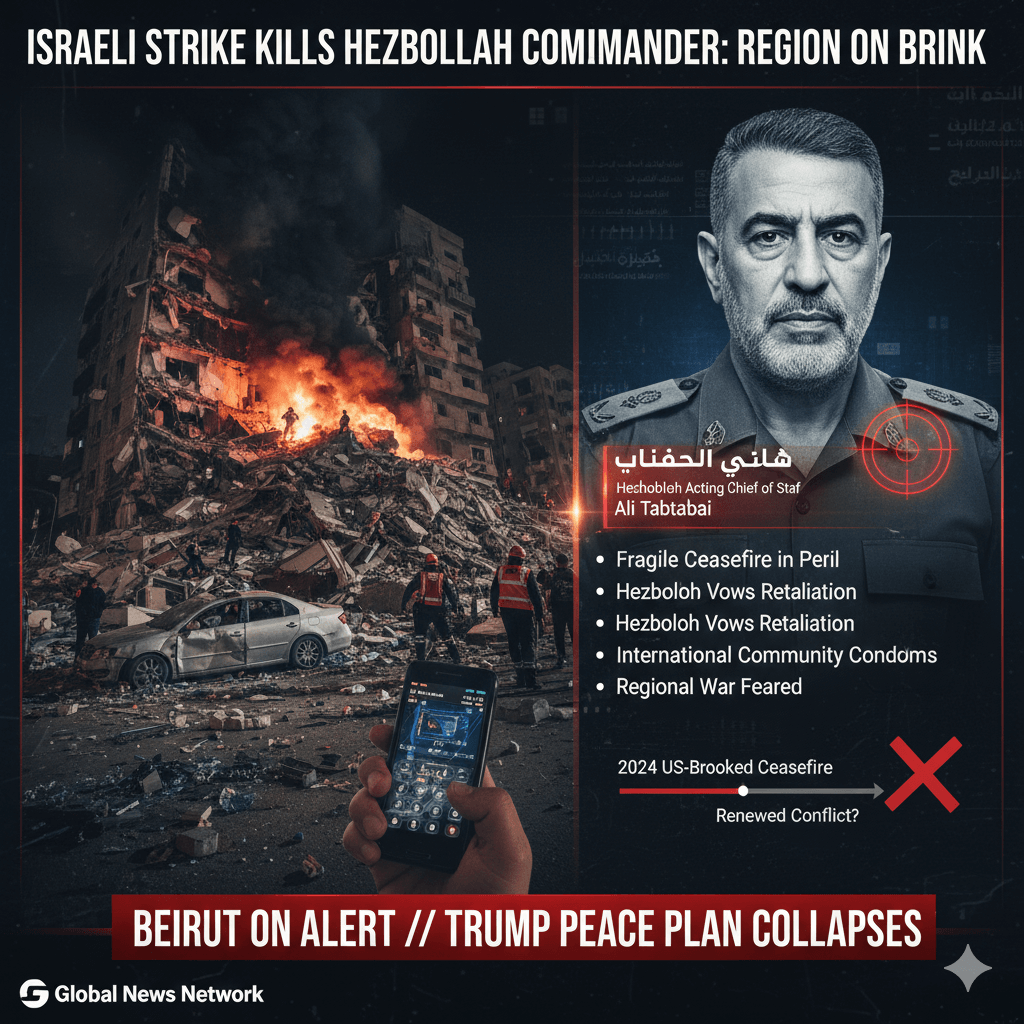
BEIRUT — An Israeli airstrike on Beirut’s southern suburbs has killed Hezbollah’s acting chief of staff, Ali (Haitham) Tabtabai, in the most significant targeted killing since the 2024 U.S.-brokered ceasefire. The strike hit a multi-storey building in Haret Hreik, part of the broader Dahiya district, long regarded as Hezbollah’s political and military heartland.
The escalation, which occurred late Tuesday evening, has raised fears of renewed conflict across the region and cast further doubt over the durability of the two-year-old ceasefire.
Casualties and Immediate Impact
Lebanese emergency services confirmed that five people were killed and between 25 and 28 others injured in the blast. Video from the scene showed a residential building reduced to rubble, debris scattered across surrounding streets, and vehicles crushed under slabs of concrete.
Residents fled nearby apartments in panic, fearing additional strikes. Local hospitals reported a surge of trauma cases, with several victims suffering severe burns and blast injuries.
A civil defence spokesperson described the strike as “one of the most destructive since the 2024 ceasefire,” citing concerns about further destabilisation in densely populated neighbourhoods.
Hezbollah’s Response
Hezbollah confirmed Tabtabai’s death within hours, declaring him a “martyr” and accusing Israel of crossing a “red line”.
In a short statement, the group said its leadership was “carefully considering the size and timing” of its response. It reiterated that it had honoured the 2024 ceasefire, noting it had conducted no cross-border attacks in over a year.
Analysts say Tabtabai, previously sanctioned by the United States and considered one of Hezbollah’s most experienced field commanders, played a pivotal role in reorganising the group after the 2023–24 war.
Israeli Statements and Motives
Israeli Prime Minister Benjamin Netanyahu said the strike demonstrated Israel’s determination to prevent Hezbollah from rebuilding its military strength.
“We will not allow Hezbollah to restore the capabilities we dismantled in 2024,” Netanyahu said, arguing that Tabtabai was actively working to re-establish Hezbollah’s combat readiness.
The Israel Defense Forces said the organisation was using the truce period to rearm and retrain, and that the targeted killing formed part of an expanded campaign across Lebanon aimed at “preventing renewed aggression”.
Israeli strikes in recent weeks have increased in frequency, including operations in the Bekaa Valley and coastal regions, though Tuesday’s attack marks a significant escalation due to its location in the capital.
Lebanese Government Reaction
Lebanese President Joseph Aoun condemned the strike as a “grave breach of sovereignty” and appealed for urgent international intervention to prevent a slide back into war.
Aoun accused Israel of repeatedly violating the 2024 ceasefire, noting continued incursions into southern Lebanon and sporadic airstrikes across multiple provinces.
The government remains under pressure from Western powers to curb Hezbollah’s military activities, yet officials have been hesitant to confront the group directly due to its influence within Lebanon’s political system.
Ceasefire and Prior War
The November 2024 ceasefire, brokered by the United States and France, ended a year-long conflict that erupted after Hezbollah launched rockets into northern Israel following the 7 October 2023 Hamas attack.
Israel subsequently launched a large-scale military campaign that resulted in the deaths of more than 4,000 people in Lebanon and displaced over one million civilians.
Multiple senior Hezbollah commanders — including long-time leader Hassan Nasrallah — were killed during the war, leaving the group to rebuild its fractured hierarchy.
Although the ceasefire dramatically reduced cross-border violence, tensions have remained high, with both sides accusing the other of infractions.
U.S. and International Elements
Tuesday’s attack has put renewed focus on the fragility of the U.S.-brokered ceasefire, which Washington has struggled to keep intact as both Israel and Hezbollah publicly express frustration with its constraints.
Tabtabai was sanctioned by the U.S. Treasury Department in 2016, and the State Department had placed a US$5 million reward on information leading to him due to his alleged involvement in cross-border operations and training of allied militias.
American officials have privately voiced concern over the slow pace of Hezbollah’s disarmament, a key condition of the 2024 agreement.
The strike also comes days before a scheduled visit to Lebanon by Pope Leo XIV, prompting heightened security and diplomatic anxiety.
Strategic and Political Implications
Regional analysts say the killing sends a clear message that Israel maintains the intelligence and operational capability to eliminate high-ranking Hezbollah figures despite international pressure to uphold the ceasefire.
The strike is widely viewed as an attempt to pressure the Lebanese government into tightening restrictions on Hezbollah’s activities and to disrupt the group’s efforts to rebuild its command structure.
However, the move carries significant risk. If Hezbollah retaliates forcefully, the region could be dragged into the most serious escalation since 2024, undoing two years of precarious stability.
“This is a highly calibrated but extremely dangerous action,” said Dr Samir Haddad, a Beirut-based security analyst. “Israel is signalling strength, but Hezbollah’s leadership cannot afford to appear passive.”
What Happens Next
Whether the ceasefire survives the coming days may depend on Hezbollah’s calculation: retaliate and risk open war, or show restraint at the cost of internal political credibility.
International diplomats have urged both sides to avoid escalation, but with emotions high and political stakes rising, the next 48 hours may prove decisive for Lebanon, Israel, and the broader region.