In the space of five days, Washington escalated its confrontation with Caracas from sanctions enforcement to a kinetic operation that, according to multiple major outlets, culminated in the capture of Venezuelan President Nicolás Maduro and the seizure of two oil tankers operating within what US officials describe as a sanctions-busting “shadow fleet”. The moves have triggered sharp legal debate, market uncertainty and a chorus of international condemnation—while also energising supporters who frame the actions as decisive strikes against narcotics trafficking and energy insecurity.
The Flashpoint (Core Event Summary)
What happened:
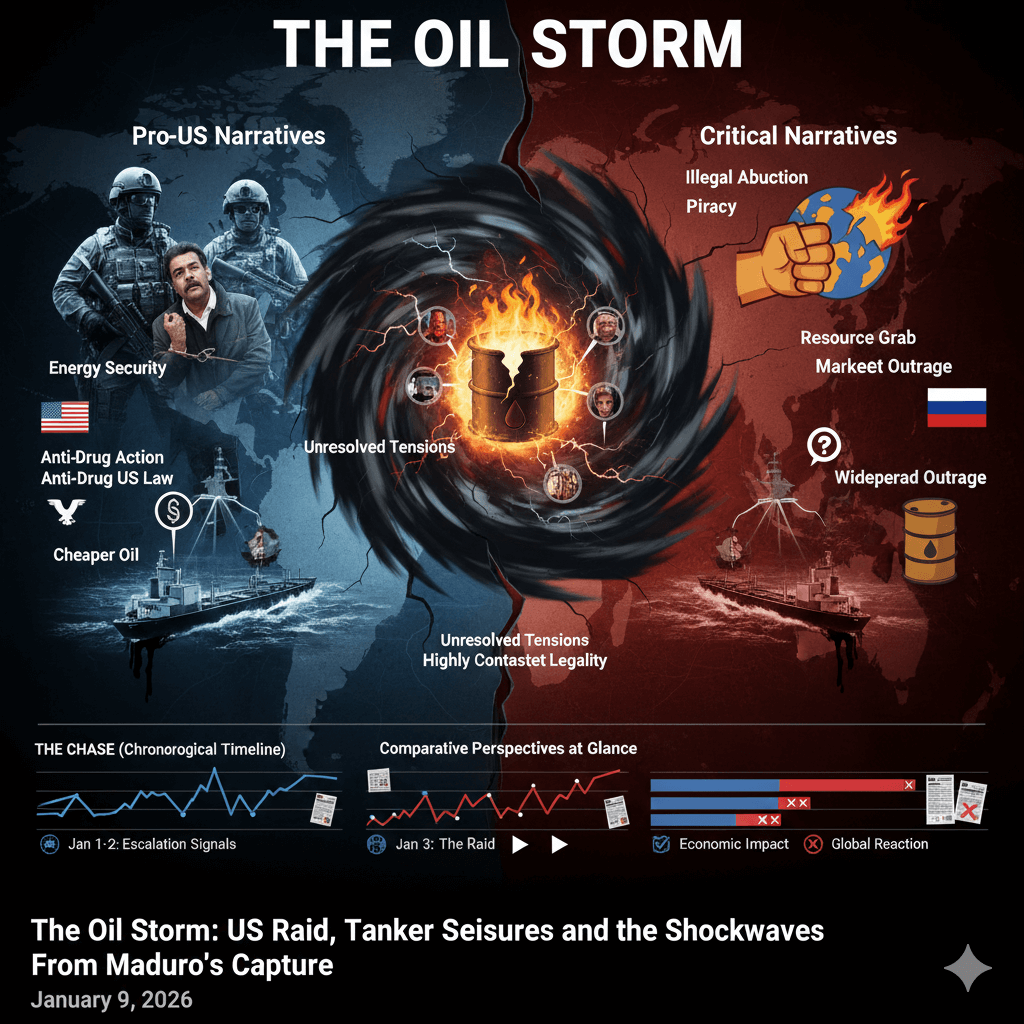
- January 3: US forces carried out a pre-dawn raid in Caracas, reportedly extracting President Nicolás Maduro and his wife, Cilia Flores. US officials say the pair were flown to New York to face longstanding narco-terrorism charges first announced in 2020.
- January 7: US naval and coastguard units seized two oil tankers—Sophia, Venezuelan-flagged, in the Caribbean, and Marinera (formerly Bella 1), Russian-flagged, in the North Atlantic following a prolonged pursuit.
Why it matters:
The actions strike at the intersection of energy security, sanctions enforcement, and international law, with implications for global oil supply, US–Russia relations, and the precedent set for cross-border law enforcement.
Stakes at a glance:
- Oil reserves: Venezuela holds an estimated 303 billion barrels, the world’s largest proven reserves.
- Energy markets: US officials claim 50 million barrels are already en route to US ports under emergency arrangements.
- Geopolitics: Russia has denounced the tanker seizure as piracy; China and several Latin American governments have criticised the intervention as unlawful.
The Chase Chronological Timeline
Pre-2026 Buildup
Since 2019, the US has imposed escalating sanctions on Venezuela, tightening financial and energy restrictions after disputed elections. A 2024 maritime blockade, reported by several outlets, further constrained exports. In response, traders and shipping firms allegedly assembled a “shadow fleet” of re-flagged or renamed vessels to move crude covertly—an approach previously observed in Iran and Russia sanctions regimes.
January 1–2: Escalation Signals
In the days preceding the raid, social media and some broadcasters reported unconfirmed US strikes near Venezuelan ports and the departure of a Russian-flagged tanker from Venezuelan waters. Claims of Russian naval or submarine shadowing circulated online but remain unverified.
January 3: The Raid
According to US briefings cited by Reuters, CNN and others, airstrikes neutralised elements of Caracas’ air defences before Delta Force personnel extracted Maduro and Flores “without casualties”. Comparisons were drawn to the 1989 capture of Panama’s Manuel Noriega—an analogy embraced by some commentators and rejected by critics as misleading.
January 7: The Seizures
US forces intercepted the Sophia in the Caribbean and boarded the Marinera in the North Atlantic after what officials described as a “weeks-long pursuit”. Moscow protested the latter seizure, asserting protection over the Russian-flagged vessel and calling the operation illegal.
The Players Multi-Perspective Voices
The US View
President Donald Trump framed the operations as necessary to “end narco-terrorism” and restore energy flows. Administration figures cited US indictments alleging that a significant share of cocaine entering North America transits Venezuela—claims disputed by independent researchers but frequently repeated in US political discourse. Conservative outlets highlighted potential energy gains and the deployment of US oil companies to revive Venezuelan infrastructure.
Venezuelan Exiles and Opposition
Among Venezuelan diaspora communities, reactions have been mixed but often hopeful. Some exiles posted on X that Maduro’s removal could open the door to democratic transition and economic recovery, recalling the nationalisation of oil assets in 1976 as a turning point that concentrated power in the state.
International Backlash
Russia condemned the tanker seizures as “piracy”, while China and several Latin American governments warned the actions undermine sovereignty. Legal scholars quoted by Al Jazeera and European outlets argue that abducting a sitting head of state without host-nation consent violates international law, regardless of domestic indictments.
Conspiracy and Counter-Narratives
X has amplified fringe theories linking the events to “Q” narratives, secret Bitcoin reserves, or imminent global conflict. Major newsrooms have treated these claims cautiously, noting a lack of evidence.
The Stakes Implications and Futures Thread
Oil Economics
Analysts cited by Bloomberg and AP say US control over Venezuelan production—if realised—could release large volumes of heavy crude favoured by Gulf Coast refineries. A surge in supply might pressure prices and reinforce dollar-denominated oil trade, challenging alternative settlement currencies. However, infrastructure degradation and labour shortages could delay any rapid ramp-up.
Geopolitical Risks
The involvement of a Russian-flagged tanker raises the risk of miscalculation. While no military response has been confirmed, European diplomats warn that naval standoffs or retaliatory sanctions could follow. Protests have been reported in parts of Venezuela, though casualty figures remain unclear.
Legal Shadows
At the heart of the debate is whether sanctions enforcement and narco-terrorism charges justify extraterritorial action. Neutral experts quoted by Reuters and the New York Times stress that, under international law, enforcement on foreign soil typically requires consent or a UN mandate—neither of which has been publicly demonstrated.
Human Consequences
Supporters argue that disrupting illicit oil and drug flows could benefit Venezuelans over time. Critics counter that abrupt regime change risks humanitarian fallout and prolonged occupation. Left-leaning outlets emphasise the lived impact of sanctions on ordinary citizens, while right-leaning voices focus on security outcomes.
Comparative Perspectives at a Glance
| Aspect | Pro-US Narratives | Critical Narratives | Neutral/Expert Views |
| Motivation | Energy security; anti-drug action | Imperialism; resource grab | Sanctions enforcement; legal charges |
| Legality | Justified under US law | Illegal abduction and piracy | Highly contested |
| Economic Impact | Cheaper oil; US gains | Market disruption | Uncertain, phased |
| Global Reaction | Predictable opposition | Widespread outrage | Mixed, cautious |
Convergence: The Horizon
The convergence of a leader’s capture and the seizure of oil tankers has exposed the fragility of global energy systems and the fault lines of international law. While sources broadly agree on what occurred, they diverge sharply on why it was done and what should follow. Key questions remain unresolved:
- When will Maduro’s trial commence, and under what jurisdictional challenges?
- Will Russia escalate diplomatically or militarily?
- Can Venezuelan oil infrastructure realistically be revived without prolonged instability?
As markets, diplomats and communities watch closely, the episode underscores a central tension of the 2020s: the clash between national security claims and the rules-based order that governs how power is exercised beyond borders.