Published: 2 January 2026
The Origin Shard – Roots and Rise
“I’m a proud Muslim coloured boy from Pakistan who was told that he would never play for the Australian cricket team. Look at me now.”
Usman Khawaja’s voice cracked as he delivered that line, not as provocation but as testimony. It was the emotional centrepiece of his retirement announcement and the most distilled expression of a career spent pushing against invisible walls.
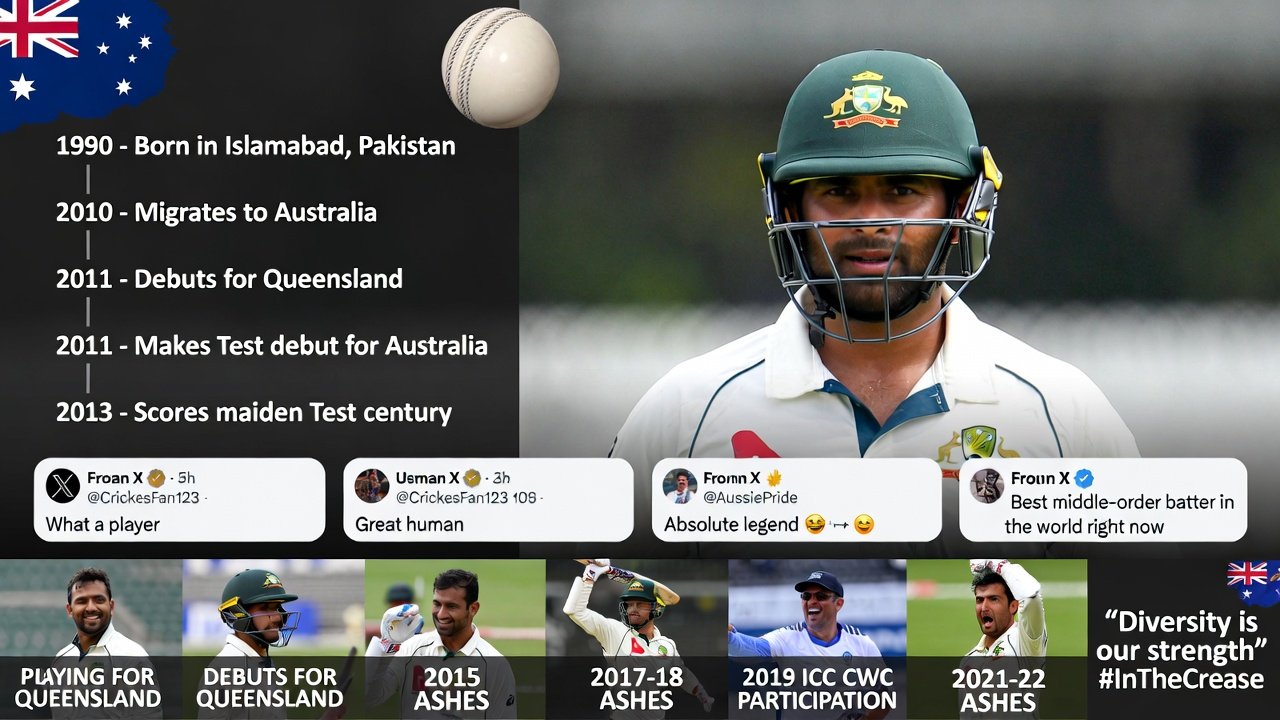
Born in Islamabad and raised in Sydney from the age of four, Khawaja grew up navigating two worlds. Cricket, however, offered little refuge from Australia’s entrenched stereotypes. The national game, long shaped by Anglo traditions, was not designed with migrants like Khawaja in mind. He has spoken candidly about being made to feel like an outsider — not quite fitting the mould of what an Australian cricketer was “supposed” to be.
Yet talent has a way of forcing doors open. Khawaja’s elegant left-handed batting carried him through the domestic system and into a Test debut in 2011. Early signs were promising, but consistency proved elusive. Dropped, recalled, and dropped again, his first decade in international cricket was defined as much by absence as opportunity.
The Performance Prism – Stats and Standouts
Strip away the symbolism and Khawaja’s numbers still command respect.Across 88 Tests, he amassed 6,206 runs at an average of just over 42, including 16 centuries. In white-ball formats, he was equally reliable, carving out a reputation as a composed anchor rather than a headline act.
His defining renaissance came late. Recalled in 2022 when many thought his time had passed, Khawaja reinvented himself as one of the world’s most reliable openers. From 2022 to 2024, he averaged nearly 59, excelling in Asia and anchoring Australia through high-pressure Ashes contests — most notably the bruising 2023 series in England, where his calm defiance contrasted sharply with the surrounding noise.
Career Phases at a Glance
| Phase | Tests Played | Runs | Centuries | Average | Key Highlight |
| Early Years (2011–2018) | 44 | 2,887 | 8 | 42.45 | Ashes debut ton, 2013 |
| Recall & Resurgence (2019–2024) | 43 | 3,319 | 8 | 52.68 | Ashes resilience, 2023 |
| Final Stretch (2025–26) | Limited | Minimal | 0 | Low | Injury absence |
The end, however, has been abrupt. Form dipped below an average of 30 in the past two seasons, and injury ruled him out of a key Ashes Test. At 39, the timing of his retirement feels less dramatic than inevitable.
The Controversy Crack – Battles Beyond the Boundary
Khawaja’s career cannot be understood solely through runs and averages.He has been one of Australian cricket’s most outspoken figures on race, faith and global politics. His advocacy for Palestine — including the now-infamous dove symbol saga — drew sanctions, support and sharp backlash in equal measure. To some, he became a conscience the sport was uncomfortable confronting; to others, a distraction from cricket’s “core business”.
He also challenged the game internally, criticising pitch preparation and professionalism, and occasionally clashing with public expectations of quiet compliance. Social media amplified both sides: praise for courage, accusations of self-entitlement, even suggestions that golf injuries and activism detracted from performance.
The Legacy Layer – Inspiration and Impact
Beyond the noise lies Khawaja’s most enduring contribution.He did not just play for Australia; he expanded the idea of who could. For young cricketers from migrant and Muslim backgrounds, his presence in the baggy green was quietly revolutionary. Khawaja has said repeatedly that if his career showed “one different kid” that they belonged, it was worth it.
On the field, he departs with a decorated résumé: multiple Ashes victories, a World Test Championship title, and a reputation as a big-game survivor. Off it, he leaves a more complex inheritance — proof that identity and excellence are not mutually exclusive.
Speculation about his next chapter ranges from overseas leagues to public life, but no plans are confirmed. For now, he steps away as a player who became, willingly or not, a symbol.
The Reaction Ripple – Voices from the Field
Tributes flowed swiftly. Teammates praised his humanity as much as his batting. Fans spoke of a 15-year journey that mirrored Australia’s slow, uneven reckoning with diversity.
Media reaction has been broadly respectful, though not uncritical. Some question whether form warranted a farewell Test at the SCG. Others argue the timing — with Australia leading the Ashes — underlines his self-awareness rather than sentimentality.
The divide feels fitting. Khawaja’s career has never been universally embraced, but it has always been deeply felt.
Assembling the Mosaic – Reflections and Farewell
Seen as a whole, Usman Khawaja’s career resembles a mosaic: fragments of brilliance, interruption, resilience and controversy forming a picture larger than any single innings.
If his final moments in the baggy green come at the SCG, they will not merely mark an ending, but a statement — that Australian cricket is no longer as narrow as it once was, and that progress, however contested, is irreversible.
The runs will fade into record books. The image of a man who refused to shrink himself to fit the game may endure far longer.